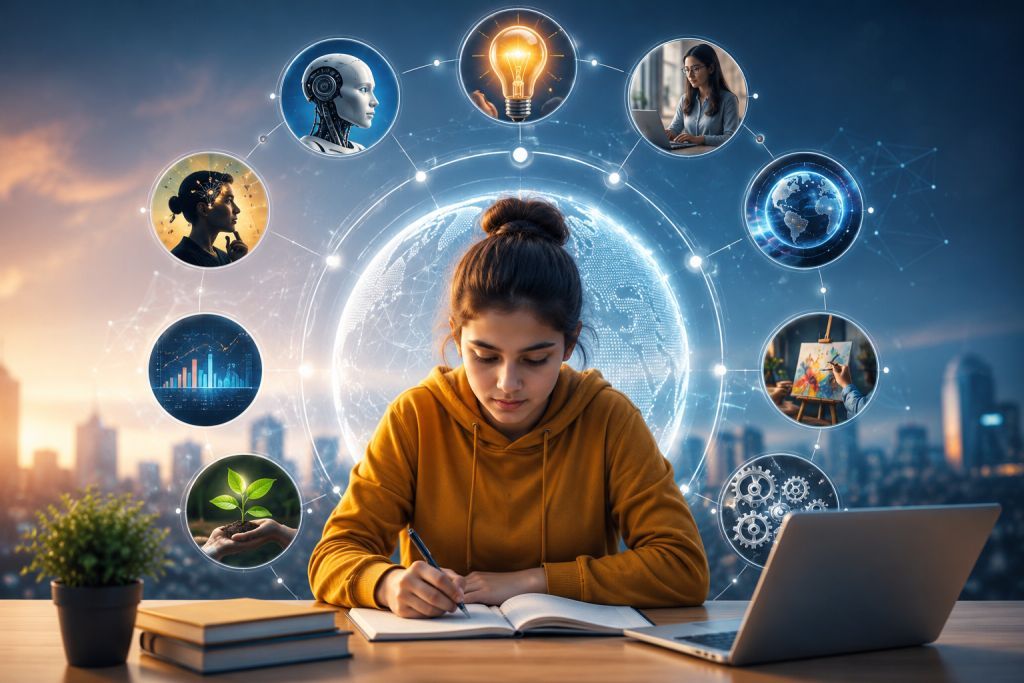
The world of education and work is changing rapidly. Advances in Artificial Intelligence, automation, robotics, cloud computing, and digital communication are transforming how people learn, work, and solve problems. Many careers that exist today will evolve significantly over the next decade, while entirely new professions will continue to emerge. As a result, students need more than academic knowledge—they need a broad set of future-ready skills that help them adapt, innovate, and thrive in a constantly changing environment.
Traditional subjects such as mathematics, science, language, and history remain important, but employers increasingly value skills that enable individuals to learn continuously, collaborate effectively, think critically, and use technology responsibly. Success in the future will depend not only on what students know but also on how quickly they can acquire new knowledge, solve unfamiliar problems, and work alongside intelligent technologies.
Artificial Intelligence is becoming an everyday productivity tool rather than a replacement for human potential. Students who understand how to use AI ethically and effectively while strengthening uniquely human abilities—such as creativity, empathy, communication, and leadership—will be better prepared for future opportunities.
This guide explores the most important skills students should develop in 2026 and beyond to succeed in higher education, future careers, entrepreneurship, and lifelong personal growth.
Quick Answer: What Skills Will Future Students Need Most?
Future students need a balanced combination of technical and human skills. The most valuable abilities include critical thinking, problem-solving, AI literacy, digital literacy, communication, creativity, emotional intelligence, adaptability, collaboration, financial literacy, and lifelong learning. These skills help students navigate rapidly changing technologies, make informed decisions, work effectively with others, and remain competitive in future careers.
Why Future-Ready Skills Matter
Technology continues to automate repetitive tasks, making uniquely human abilities increasingly valuable. Employers seek individuals who can analyze information, adapt to change, communicate ideas clearly, and collaborate across disciplines.
Future-ready skills help students:
- Adapt to changing careers.
- Solve complex problems.
- Use technology effectively.
- Work with AI responsibly.
- Communicate across cultures.
- Continue learning throughout life.
- Build resilience during change.
Rather than preparing for one specific profession, students should develop transferable skills that remain useful across many industries.
How Education Is Changing in 2026 and Beyond
Education is moving beyond memorization toward practical application, collaboration, creativity, and digital competence.
Key trends include:
- Greater use of AI-powered learning tools.
- Personalized education.
- Project-based learning.
- Hybrid and online learning environments.
- Greater emphasis on practical skills.
- Interdisciplinary learning.
- Continuous professional development.
Students who embrace these changes are more likely to succeed in rapidly evolving workplaces.
1. Critical Thinking
Critical thinking remains one of the most valuable skills because information is now widely available. The challenge is determining whether that information is accurate, relevant, and trustworthy.
Critical thinkers can:
- Evaluate evidence.
- Question assumptions.
- Identify bias.
- Compare multiple viewpoints.
- Make informed decisions.
- Solve unfamiliar problems.
As AI generates increasing amounts of content, critical evaluation becomes even more important.
2. Problem-Solving Skills
Future careers will increasingly require people to solve new and complex problems rather than repeat routine tasks.
Strong problem-solvers:
- Analyze situations carefully.
- Break problems into smaller parts.
- Develop creative solutions.
- Test ideas.
- Learn from mistakes.
- Improve continuously.
Problem-solving combines analytical thinking with creativity and practical decision-making.
3. Digital Literacy
Digital literacy goes beyond using computers. It includes understanding digital tools, evaluating online information, protecting personal data, and communicating effectively through technology.
Digital literacy includes:
- Online research.
- Cloud collaboration.
- Cybersecurity awareness.
- Data management.
- Digital communication.
- Responsible technology use.
These skills are valuable across nearly every profession.
4. AI Literacy
Artificial Intelligence is becoming a common workplace tool, making AI literacy an essential future skill.
Students should understand:
- What AI can and cannot do.
- How AI systems generate responses.
- Responsible AI usage.
- Prompt writing basics.
- Ethical considerations.
- How to verify AI-generated information.
Rather than replacing learning, AI should support research, creativity, productivity, and problem-solving.
5. Communication Skills
Clear communication remains essential regardless of technological advances.
Students should develop:
- Public speaking.
- Professional writing.
- Listening skills.
- Presentation abilities.
- Cross-cultural communication.
- Digital communication etiquette.
Strong communicators explain ideas effectively and collaborate more successfully with diverse teams.
6. Creativity and Innovation
While AI can assist with generating ideas, human creativity remains essential for developing original solutions, designing products, solving complex challenges, and driving innovation.
Creative students often:
- Generate new ideas.
- Think beyond conventional solutions.
- Experiment with different approaches.
- Combine knowledge from multiple disciplines.
- Embrace curiosity.
7. Emotional Intelligence
Emotional intelligence helps students understand and manage their emotions while building positive relationships with others.
Important components include:
- Self-awareness.
- Empathy.
- Self-regulation.
- Conflict resolution.
- Relationship building.
- Leadership.
These abilities strengthen teamwork and workplace collaboration.
8. Adaptability and Lifelong Learning
Technology evolves quickly, making continuous learning an essential career skill.
Adaptable students:
- Learn new technologies.
- Accept feedback.
- Develop new skills regularly.
- Respond positively to change.
- Remain curious.
- Seek continuous improvement.
Lifelong learning enables individuals to remain competitive throughout changing careers.
9. Collaboration and Teamwork
Modern workplaces increasingly rely on cross-functional teams that bring together diverse expertise.
Effective collaboration involves:
- Sharing ideas respectfully.
- Supporting teammates.
- Managing disagreements constructively.
- Accepting different perspectives.
- Working toward shared goals.
Strong teamwork skills improve productivity and encourage innovation.
10. Financial Literacy
Understanding personal finance helps students make informed financial decisions throughout adulthood.
Key financial literacy topics include:
- Budgeting.
- Saving.
- Investing basics.
- Managing debt responsibly.
- Understanding taxes.
- Evaluating financial risk.
Financial knowledge supports independence, responsible decision-making, and long-term financial well-being while complementing academic and professional success.
Future Skills Comparison
| Skill | Why It Matters | Future Demand |
|---|---|---|
| Critical Thinking | Evaluates information and solves complex problems | Very High |
| AI Literacy | Works effectively with AI technologies | Very High |
| Digital Literacy | Uses technology safely and efficiently | Very High |
| Communication | Shares ideas clearly across teams | Very High |
| Creativity | Develops innovative solutions | High |
| Problem-Solving | Handles unfamiliar challenges | Very High |
| Emotional Intelligence | Builds relationships and leadership | High |
| Financial Literacy | Supports smart financial decisions | High |
Technical Skills vs Soft Skills
| Technical Skills | Soft Skills |
|---|---|
| AI Literacy | Communication |
| Digital Literacy | Leadership |
| Data Analysis | Teamwork |
| Cybersecurity Awareness | Critical Thinking |
| Cloud Computing Basics | Adaptability |
| Coding Fundamentals | Creativity |
| Information Research | Emotional Intelligence |
Most Valuable Digital Skills
| Digital Skill | Application |
|---|---|
| AI Tools | Research, productivity, and automation |
| Online Collaboration | Remote teamwork |
| Cybersecurity | Protecting personal and organizational data |
| Digital Communication | Email, messaging, and virtual meetings |
| Data Interpretation | Making informed decisions |
| Content Creation | Presentations, videos, and digital media |
| Information Evaluation | Identifying credible online sources |
Benefits of Developing Future-Ready Skills
| Benefit | Description |
|---|---|
| Career Readiness | Improves employability across industries. |
| Adaptability | Helps respond to technological changes. |
| Better Decision-Making | Supports critical thinking and problem-solving. |
| Improved Collaboration | Strengthens teamwork and communication. |
| Higher Productivity | Uses digital tools more efficiently. |
| Lifelong Learning | Encourages continuous personal and professional growth. |
Advantages and Challenges
| Advantages | Challenges |
|---|---|
| Greater career flexibility | Rapid technological change |
| Improved employability | Continuous learning is required |
| Higher confidence | Learning multiple new skills takes time |
| Better collaboration | Balancing technical and soft skills |
| Stronger innovation | Keeping knowledge up to date |
| More career opportunities | Adapting to changing workplace expectations |
Common Mistakes Students Make
| Mistake | Better Approach |
|---|---|
| Focusing only on grades | Develop practical skills alongside academics |
| Avoiding technology | Learn to use digital and AI tools responsibly |
| Ignoring communication skills | Practice writing, speaking, and presenting regularly |
| Not learning about personal finance | Understand budgeting and financial planning early |
| Resisting change | Develop adaptability and curiosity |
| Stopping learning after school | Adopt a lifelong learning mindset |
Tips for Developing Future-Ready Skills
Practice Continuous Learning
Read books, take online courses, attend workshops, and explore new technologies regularly. Consistent learning helps students remain adaptable throughout their careers.
Work on Real Projects
Participating in school projects, internships, volunteer work, or personal initiatives develops practical experience and problem-solving abilities.
Use AI as a Learning Assistant
AI can support brainstorming, research, practice questions, and explanations, but students should always verify information and continue developing independent thinking.
Improve Communication Every Day
Writing clearly, presenting ideas confidently, and listening actively strengthen both academic and professional success.
Develop Both Technical and Human Skills
The strongest future professionals combine technology knowledge with creativity, empathy, collaboration, and leadership.
Career Preparation Strategies
Build a Digital Portfolio
Document projects, presentations, certifications, and achievements to demonstrate practical skills to universities and employers.
Learn Basic Data Skills
Understanding how to organize, interpret, and communicate data is increasingly valuable across industries.
Gain Practical Experience
Internships, freelancing, student organizations, competitions, and community projects help students apply classroom learning in real situations.
Develop a Growth Mindset
View challenges as opportunities to improve. Learning from mistakes and seeking feedback encourages continuous development.
Stay Informed About Emerging Technologies
Follow developments in AI, cybersecurity, sustainability, robotics, biotechnology, and digital transformation to understand how industries are evolving.
Featured Snippet: What Skills Will Future Students Need Most?
Future students need a combination of technical and human skills to succeed in an AI-driven world. The most important skills include critical thinking, problem-solving, AI literacy, digital literacy, communication, creativity, emotional intelligence, collaboration, adaptability, financial literacy, and lifelong learning. These abilities help students use technology responsibly, solve complex problems, work effectively with others, and adapt to changing careers and industries.
Frequently Asked Questions
1. What is the most important future skill?
Critical thinking is widely considered one of the most valuable skills because it helps students evaluate information, solve problems, and make informed decisions.
2. Why is AI literacy important for students?
AI literacy enables students to understand AI capabilities, use AI tools responsibly, evaluate AI-generated content, and collaborate effectively with intelligent technologies.
3. Will coding remain an important skill?
Basic programming knowledge can be valuable, but understanding technology, problem-solving, and computational thinking are equally important.
4. Are soft skills becoming more valuable?
Yes. Communication, teamwork, empathy, adaptability, and leadership continue to be highly valued because they complement technical expertise.
5. How can students prepare for jobs that don't exist yet?
Develop transferable skills such as learning quickly, thinking critically, adapting to change, communicating effectively, and using technology responsibly.
6. Is creativity still important in the AI era?
Yes. Human creativity drives innovation, original thinking, and problem-solving, even when AI assists with routine tasks.
7. Why is financial literacy important?
Financial literacy helps students manage money, plan for the future, understand investments, and make informed financial decisions.
8. How can students become lifelong learners?
Stay curious, seek feedback, explore new subjects, and continue learning through courses, books, and practical experiences throughout life.
9. What role does emotional intelligence play?
It strengthens relationships, teamwork, leadership, and conflict resolution while supporting personal well-being.
10. Should students focus more on technology than academics?
No. A balanced education that combines academic knowledge, technical skills, and personal development provides the strongest foundation.
11. Can AI replace the need to learn?
No. AI is a tool that supports learning, but students still need knowledge, judgment, creativity, and critical thinking.
12. What industries will value these skills?
Healthcare, technology, finance, education, engineering, business, government, manufacturing, and creative industries all benefit from future-ready skills.
13. How can teamwork improve future careers?
Most modern workplaces depend on collaboration, making teamwork essential for productivity, innovation, and leadership.
14. Why is adaptability important?
Technology and workplaces change rapidly, so the ability to learn new skills and adjust to change is essential for long-term success.
15. Can students develop these skills outside school?
Yes. Volunteering, internships, hobbies, online courses, competitions, and personal projects all help build future-ready skills.
16. How can students improve communication skills?
Practice writing, public speaking, presentations, active listening, and constructive discussions with others.
17. What is the biggest advantage of future-ready skills?
They help students remain adaptable, employable, and confident throughout changing careers, emerging technologies, and lifelong learning.
Summary
The future belongs to students who combine academic knowledge with practical, transferable skills. While technology—including Artificial Intelligence—will continue to transform education and work, human abilities such as critical thinking, creativity, communication, emotional intelligence, adaptability, and collaboration will remain essential. At the same time, digital literacy, AI literacy, financial literacy, and lifelong learning will enable students to work effectively with new technologies and respond confidently to change.
Preparing for the future is not about predicting a single career path; it is about building a flexible skill set that remains valuable across industries and throughout life. Students who embrace continuous learning, apply knowledge through real-world experiences, and balance technical expertise with strong interpersonal skills will be better equipped to succeed in higher education, future careers, entrepreneurship, and an increasingly connected global economy.
Sources
- World Economic Forum – Future of Jobs Report
- OECD – Education and Skills
- UNESCO – Education Resources
- Edutopia – Teaching and Learning Strategies
- American Psychological Association – Learning Resources
- The Learning Scientists – Evidence-Based Learning
- OpenAI – AI Research
- Microsoft Learn – Technology Skills
- Grow with Google – Career and Digital Skills
- IBM SkillsBuild – Professional Learning Resources