Evidence is one of the most important components of any personal injury case. Whether an accident involves a motor vehicle collision, a slip and fall, a defective product, or another type of injury, the ability to prove what happened and demonstrate the extent of the damages often depends on the quality of the available evidence.
Insurance companies, attorneys, and courts rely on evidence to evaluate liability, determine the seriousness of injuries, verify financial losses, and assess the credibility of each party's version of events. Even a strong legal claim can become difficult to prove if important evidence is lost, destroyed, or never collected.
Evidence comes in many forms. Medical records document injuries and treatment. Photographs capture accident scenes and visible injuries. Witnesses may provide independent accounts of what happened. Employment records can demonstrate lost income, while repair estimates and receipts help establish financial damages. In more complex cases, expert witnesses may also provide professional opinions regarding accident reconstruction, medical treatment, or long-term financial losses.
Collecting and preserving evidence as early as possible can significantly strengthen a personal injury claim and improve the ability to establish both liability and damages.
Quick Answer: What Evidence Do I Need for a Personal Injury Case?
Important evidence in a personal injury case may include medical records, hospital bills, accident reports, photographs, videos, witness statements, employment records, repair estimates, receipts, expert opinions, physical evidence, and digital records such as surveillance footage or dashcam videos. The specific evidence needed depends on the facts of each case and the applicable law.
Why Evidence Matters in Personal Injury Cases
Evidence helps establish two essential elements of a personal injury claim:
- Who was responsible for the accident.
- What damages resulted from the accident.
Without sufficient supporting evidence, proving liability or demonstrating the full extent of an injury may become significantly more difficult.
Strong documentation often improves the accuracy of claim evaluations and facilitates settlement discussions.
Understanding the Burden of Proof
In most personal injury cases, the injured party generally has the responsibility to present sufficient evidence supporting the claim.
This commonly includes evidence showing:
- An accident occurred.
- The defendant had legal responsibility.
- The accident caused the injuries.
- The injuries resulted in measurable damages.
The exact legal standards vary depending on the applicable jurisdiction.
Medical Records
Medical records are often among the most important pieces of evidence in a personal injury case.
These records may document:
- Emergency treatment
- Hospital admissions
- Medical diagnoses
- Physician observations
- Surgical procedures
- Physical therapy
- Rehabilitation progress
- Recovery timeline
Medical documentation helps establish both the existence of an injury and its relationship to the accident.
Medical Bills and Treatment Expenses
Medical expenses help demonstrate the financial impact of an injury.
Important documents may include:
- Hospital invoices
- Doctor bills
- Prescription receipts
- Rehabilitation expenses
- Medical equipment purchases
- Travel expenses for treatment where applicable
Keeping organized financial records helps support claims for economic damages.
Accident Reports
Official accident reports often provide valuable information about the incident.
Depending on the circumstances, reports may be prepared by:
- Police officers
- Highway patrol
- Property owners
- Employers
- Workplace safety personnel
- Government agencies
These reports frequently contain observations, diagrams, witness information, and preliminary findings regarding the accident.
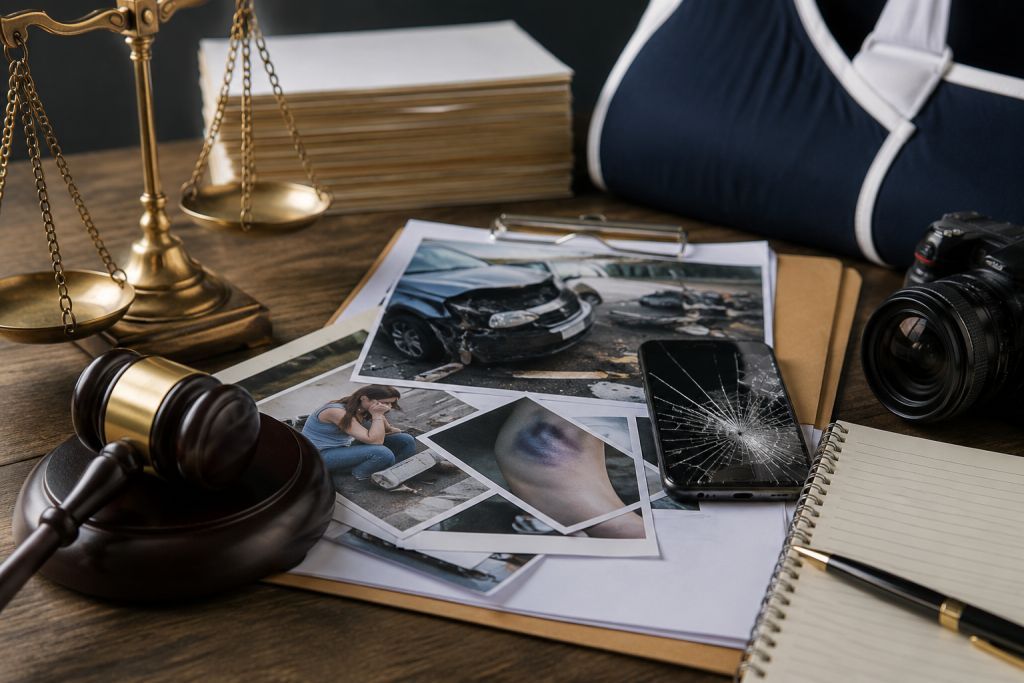
Photographs and Videos
Visual evidence can preserve important details that may change over time.
Helpful photographs may include:
- Accident scene
- Road conditions
- Weather conditions
- Vehicle damage
- Property damage
- Visible injuries
- Hazardous conditions
- Traffic signs or signals
Videos from smartphones, dashcams, surveillance cameras, or nearby businesses may also provide valuable evidence.
Witness Statements
Independent witnesses can often provide objective descriptions of what occurred.
Witnesses may help establish:
- How the accident happened
- Who appeared responsible
- Weather conditions
- Road conditions
- Behavior of the parties
- Immediate observations after the accident
Collecting witness names and contact information as soon as possible is often beneficial.
Employment Records and Lost Wage Documentation
If an injury prevents someone from working, employment records may help establish financial losses.
Useful documentation includes:
- Payroll records
- Pay stubs
- Tax returns
- Employer verification letters
- Attendance records
- Disability leave documentation
These records may support claims involving lost income or reduced earning capacity.
Expert Witness Evidence
Some personal injury cases involve technical or medical issues requiring professional analysis.
Experts may provide opinions regarding:
- Medical treatment
- Future care needs
- Accident reconstruction
- Engineering issues
- Economic losses
- Vocational limitations
Expert opinions are particularly common in cases involving severe injuries or disputed liability.
Physical Evidence
Physical objects related to the accident may also become important evidence.
Examples include:
- Damaged vehicle parts
- Broken safety equipment
- Defective products
- Damaged clothing
- Protective gear
- Tools or equipment involved in the accident
Whenever possible, physical evidence should be preserved in its original condition.
Digital Evidence
Modern technology has significantly expanded the types of evidence available in personal injury cases.
Examples of digital evidence include:
- Dashcam recordings
- Security camera footage
- Mobile phone photographs
- GPS location data
- Vehicle event data (where available)
- Electronic communications
- Timestamped videos
- Smart device records
Because some digital evidence may be automatically deleted or overwritten, preserving it promptly can be important.
Keeping a Personal Injury Journal
In addition to formal records, many injured individuals maintain a written journal documenting their recovery.
A journal may include:
- Daily pain levels
- Medical appointments
- Physical limitations
- Medication side effects
- Missed workdays
- Activities that can no longer be performed
Although a personal journal does not replace medical records or other objective evidence, it may help document how an injury affects daily life over time.
Personal Injury Evidence Checklist
| Evidence | Purpose |
|---|---|
| Medical Records | Prove injuries and treatment |
| Medical Bills | Document financial losses |
| Police or Accident Report | Document accident details |
| Photographs | Show injuries, damage, and accident scene |
| Videos | Capture the accident or surrounding conditions |
| Witness Statements | Provide independent accounts |
| Employment Records | Support lost wage claims |
| Repair Estimates | Establish property damage |
| Receipts | Document out-of-pocket expenses |
| Expert Reports | Explain technical or medical issues |
Comparison of Common Types of Evidence
| Evidence Type | What It Helps Prove |
|---|---|
| Medical Records | Nature and extent of injuries |
| Accident Reports | How the accident occurred |
| Photographs | Scene conditions and visible injuries |
| Videos | Timeline and accident sequence |
| Witness Testimony | Independent observations |
| Employment Records | Lost income |
| Medical Bills | Economic damages |
| Expert Opinions | Complex medical or technical issues |
| Physical Evidence | Damage or defective products |
| Digital Evidence | Electronic documentation of events |
Evidence Strength Guide
| Evidence | Typical Importance |
|---|---|
| Medical Records | Very High |
| Accident Report | Very High |
| Photographs | High |
| Witness Statements | High |
| Medical Bills | High |
| Employment Records | High |
| Expert Reports | High |
| Videos | Very High |
| Receipts | Medium |
| Personal Journal | Medium |
Benefits of Strong Evidence
| Benefit | Description |
|---|---|
| Supports Liability | Helps establish responsibility for the accident. |
| Documents Damages | Shows the financial and personal impact of the injury. |
| Strengthens Negotiations | Provides support during insurance discussions. |
| Improves Credibility | Objective documentation supports factual claims. |
| Protects Legal Rights | Preserves important information before it is lost. |
| Supports Court Proceedings | Provides documentation if litigation becomes necessary. |
Pros and Cons of Different Evidence Types
| Pros | Cons |
|---|---|
| Medical records are objective | Some records may take time to obtain |
| Photographs preserve conditions | Images may not show every detail |
| Witnesses provide independent accounts | Memories can fade over time |
| Videos may capture the entire event | Surveillance footage may be deleted if not requested promptly |
| Employment records support wage losses | Some employers require formal requests |
| Expert testimony explains technical issues | Experts may increase litigation costs |
Common Evidence Mistakes to Avoid
Waiting Too Long to Gather Evidence
Important evidence such as surveillance footage or witness recollections may become unavailable over time.
Failing to Seek Medical Treatment
Delays in medical care can make it more difficult to document injuries and establish their connection to the accident.
Discarding Damaged Property
Damaged clothing, equipment, or defective products may become important physical evidence.
Not Saving Receipts
Medical expenses, travel costs, and other out-of-pocket expenses should be documented whenever possible.
Ignoring Digital Evidence
Dashcam recordings, surveillance footage, and smartphone photos may provide valuable information but can sometimes be overwritten or deleted.
Posting Accident Details on Social Media
Public posts or photographs may become part of the evidence reviewed during an insurance claim or lawsuit.
How to Preserve Evidence After an Accident
Take Photographs Immediately
Photograph injuries, property damage, road conditions, weather, and the surrounding area before conditions change.
Obtain Medical Evaluation Promptly
Medical records created soon after the accident often provide important documentation of injuries.
Collect Witness Information
Record names, telephone numbers, and contact details for anyone who observed the incident.
Keep Every Document
Save bills, receipts, insurance correspondence, repair estimates, prescriptions, and employment records.
Request Copies of Official Reports
Obtain police reports, workplace reports, or property incident reports whenever available.
Back Up Digital Files
Store photographs, videos, emails, and electronic documents in multiple secure locations.
Featured Snippet: What Evidence Do I Need for a Personal Injury Case?
Important evidence in a personal injury case commonly includes medical records, accident reports, photographs, videos, witness statements, medical bills, employment records, repair estimates, receipts, expert opinions, and physical or digital evidence. Strong documentation helps establish liability, prove damages, and support negotiations with insurance companies or court proceedings.
Frequently Asked Questions
1. What is the most important evidence in a personal injury case?
Medical records and evidence establishing liability are often among the most important forms of documentation.
2. Do photographs help prove my claim?
Yes. They may document injuries, property damage, and accident conditions.
3. Should I keep every medical bill?
Yes. Medical expenses often support claims for economic damages.
4. Are witness statements important?
Independent witness observations may help explain how an accident occurred.
5. Can surveillance footage be used?
Depending on availability and applicable law, surveillance footage may become valuable evidence.
6. Should I keep damaged property?
When practical, damaged items may serve as useful physical evidence.
7. Can employment records help my case?
Yes. They may support claims involving lost wages or reduced earning capacity.
8. What is digital evidence?
Electronic evidence such as dashcam videos, GPS data, emails, text messages, or security recordings.
9. Are receipts important?
Yes. Receipts document expenses related to the injury.
10. Should I keep a recovery journal?
A journal may help document symptoms, treatment, and the impact of injuries on daily life.
11. Can expert witnesses help?
Experts may explain technical, medical, engineering, or financial issues in complex cases.
12. What if there were no witnesses?
Medical records, photographs, videos, and other documentation may still support the claim.
13. How soon should I collect evidence?
As soon as reasonably possible after the accident.
14. Can social media affect my claim?
Public posts may become relevant during an insurance claim or lawsuit.
15. Should I obtain a copy of the accident report?
Yes. Official reports often contain useful factual information.
16. Can videos strengthen my claim?
Yes. Videos may capture important details that photographs alone cannot show.
17. Why is evidence preservation so important?
Preserving evidence helps maintain accurate documentation before records disappear or memories fade.
Summary
Strong evidence is the foundation of a successful personal injury claim. Medical records, accident reports, photographs, witness statements, employment records, receipts, expert opinions, and digital evidence each play an important role in demonstrating liability and proving damages. The more complete and organized the evidence, the easier it becomes to evaluate the claim and support requests for compensation.
Because evidence can quickly disappear after an accident, individuals should act promptly to document injuries, preserve physical items, obtain official reports, and organize financial records. Taking these steps early can strengthen both insurance claims and court proceedings while helping protect important legal rights.
Sources
- American Bar Association – Consumer Legal Resources
- Nolo – Personal Injury Law Center
- Cornell Legal Information Institute – Law of Evidence
- FindLaw – Personal Injury Resources
- U.S. Department of Justice – Legal Resources
- Insurance Information Institute – Insurance Claims Information
- LawHelp.org – Legal Information
- Consumer Financial Protection Bureau – Consumer Resources
- Centers for Disease Control and Prevention – Injury Prevention
- National Safety Council – Injury and Safety Resources