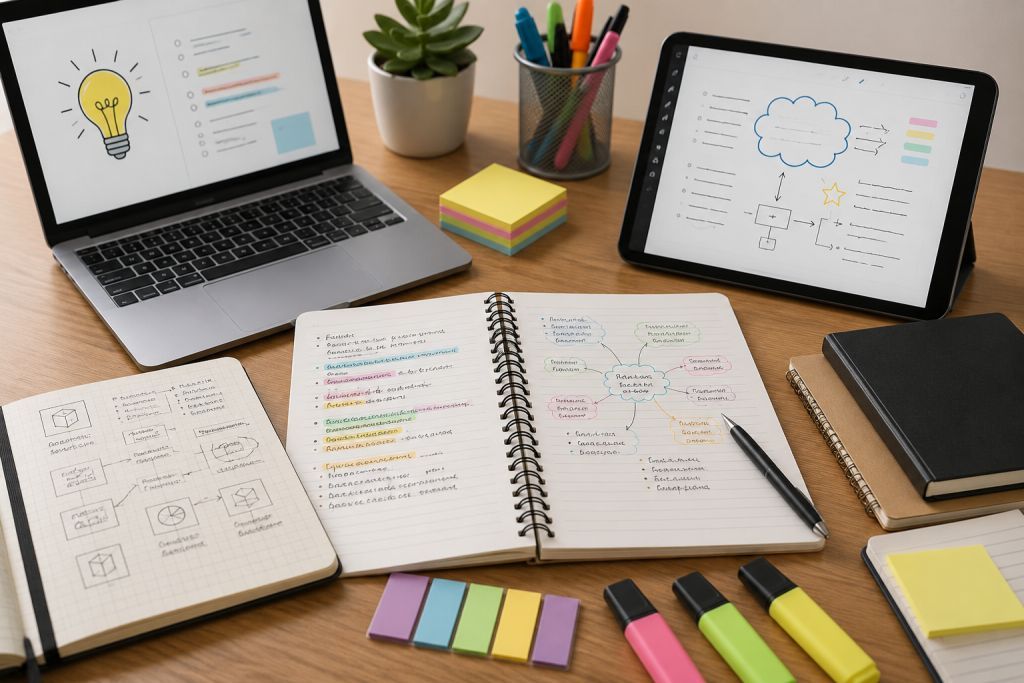
Taking notes is one of the most important learning skills a student can develop. Good notes help organize information, improve understanding, support memory, and make exam preparation significantly easier. However, many students write down everything they hear or read without organizing ideas, making their notes difficult to review later.
Research in education and cognitive psychology suggests that effective note-taking is not about recording every word. Instead, successful students focus on identifying key concepts, organizing information logically, connecting related ideas, and reviewing their notes regularly. Well-structured notes encourage active learning rather than passive copying.
Today, students can choose between handwritten notebooks, tablets, laptops, and note-taking applications. Each option has advantages depending on the subject, learning style, and study goals. Regardless of the format, the most effective note-taking systems help students process information while learning and retrieve it efficiently during revision.
This guide explores the best note-taking methods for students, explains when to use each approach, and provides practical tips for creating organized notes that improve understanding, memory, and academic performance.
Quick Answer: What Are the Best Note-Taking Methods for Students?
The best note-taking methods include the Cornell Note-Taking System, Outline Method, Mind Mapping, Charting Method, Flow-Based Notes, and the Sentence Method. The most effective approach depends on the subject and learning style, but combining organized notes with active recall and regular review generally leads to better understanding, stronger memory, and improved exam performance.
Why Note-Taking Is Important
Note-taking is much more than recording classroom information. It helps students actively process ideas while learning, making it easier to understand and remember new material.
Good note-taking helps students:
- Improve concentration during lectures.
- Identify key concepts.
- Organize information logically.
- Remember material for longer.
- Prepare efficiently for exams.
- Develop critical thinking skills.
- Reduce study time during revision.
Students who consistently create organized notes often find reviewing easier because important information is already summarized and structured.
Characteristics of Effective Notes
Effective notes are not necessarily long or detailed. Instead, they capture essential information in a clear and organized format.
Good notes usually include:
- Clear headings.
- Important definitions.
- Key ideas rather than full paragraphs.
- Examples where helpful.
- Diagrams or visual aids.
- Questions for later review.
- Logical organization.
The goal is to make information easy to understand and quick to review.
1. Cornell Note-Taking System
The Cornell Method is one of the most widely recommended note-taking systems because it combines organization, active recall, and revision.
The page is divided into three sections:
- Main notes section.
- Keyword or question column.
- Summary section.
During class, students record important information in the main section. Later, they add keywords or questions in the left column and write a brief summary at the bottom.
This method encourages active review because students can cover the main notes and answer questions using memory.
It works particularly well for:
- University lectures.
- Science subjects.
- History.
- Business studies.
- Exam revision.
2. Outline Method
The Outline Method organizes information into headings and subheadings.
Main topics appear first, followed by supporting details underneath.
For example:
- Main Topic
- Subtopic
- Important Detail
- Example
This approach creates a logical structure that makes reviewing easier.
It works best for:
- Textbook reading.
- Lectures.
- Essay planning.
- Theoretical subjects.
3. Mind Mapping Method
Mind maps organize information visually by connecting related ideas around a central topic.
Students begin with the main concept in the center and create branches for supporting ideas.
Mind mapping helps students:
- Visualize relationships.
- Understand complex topics.
- Improve memory.
- Generate ideas.
- Review large subjects quickly.
This method is especially useful for brainstorming, biology, business studies, psychology, literature, and project planning.
4. Charting Method
The Charting Method organizes information into tables with columns and rows.
Each column represents a category, making comparisons easier.
This method is excellent for:
- Comparing theories.
- Historical events.
- Scientific classifications.
- Business case studies.
- Language learning.
When subjects involve many similarities and differences, charts provide an efficient review format.
5. Flow-Based Note-Taking
Flow Notes encourage students to capture ideas naturally instead of writing everything in strict order.
Students connect concepts using arrows, diagrams, symbols, sketches, and brief explanations.
This approach promotes deeper understanding by encouraging students to think actively about relationships between ideas instead of copying information word for word.
Flow Notes are particularly useful for conceptual subjects where understanding connections is more important than memorizing isolated facts.
6. Sentence Method
The Sentence Method records information as individual numbered statements.
Each new idea is written on a separate line.
This approach is simple and works well during fast-paced lectures where information changes quickly.
Although organization may require additional work later, it ensures students capture important information without falling behind.
Handwritten vs Digital Notes
Modern students often choose between notebooks and digital devices. Both approaches have strengths.
Handwritten Notes
Writing by hand generally requires students to summarize information instead of copying everything, encouraging deeper processing and understanding.
Advantages include:
- Improved concentration.
- Better memory.
- Fewer distractions.
- Flexible diagrams and sketches.
Digital Notes
Digital note-taking allows students to organize large amounts of information efficiently.
Benefits include:
- Easy searching.
- Cloud synchronization.
- Quick editing.
- Multimedia support.
- Simple sharing.
- Organization across multiple subjects.
Many students combine handwritten notes during lectures with digital organization afterward to benefit from both approaches.
Tips for Better Note-Taking
Regardless of the method you choose, effective note-taking depends on consistency and thoughtful organization.
- Listen for key ideas rather than writing every word.
- Use headings and subheadings.
- Highlight important concepts selectively.
- Use abbreviations for speed.
- Leave space to add information later.
- Review notes within 24 hours.
- Summarize lessons in your own words.
- Add diagrams whenever they improve understanding.
- Ask questions in the margins for future review.
- Combine notes with active recall and practice questions.
Well-organized notes become powerful learning tools when they are reviewed regularly rather than stored away until the night before an exam.
Comparison of Note-Taking Methods
| Method | Best For | Organization | Revision Efficiency |
|---|---|---|---|
| Cornell Method | Lectures and exam preparation | Excellent | Very High |
| Outline Method | Textbooks and theory subjects | Excellent | High |
| Mind Mapping | Visual learners and brainstorming | High | High |
| Charting Method | Comparisons and classifications | Very High | High |
| Flow Notes | Concept-based learning | Moderate | High |
| Sentence Method | Fast-paced lectures | Basic | Moderate |
Handwritten vs Digital Notes
| Feature | Handwritten Notes | Digital Notes |
|---|---|---|
| Memory Retention | Generally stronger | Good with active review |
| Speed | Moderate | Fast typing and editing |
| Organization | Manual | Searchable folders and tags |
| Editing | Limited | Easy to modify |
| Drawing Diagrams | Excellent | Depends on device |
| Accessibility | Notebook only | Available across devices |
| Distractions | Very Low | Higher unless notifications are disabled |
Popular Note-Taking Apps
| App Type | Purpose |
|---|---|
| Cloud Note Apps | Create, organize, and sync notes |
| Digital Notebook Apps | Handwritten notes on tablets |
| Markdown Editors | Structured note-taking for technical subjects |
| Flashcard Apps | Active recall and spaced repetition |
| Mind Mapping Software | Visual organization of ideas |
| PDF Annotation Tools | Highlight and comment on study materials |
| Task Management Apps | Study planning and assignment tracking |
| Cloud Storage | Backup and access notes anywhere |
Benefits of Good Note-Taking
| Benefit | Description |
|---|---|
| Better Understanding | Encourages active processing of information. |
| Improved Memory | Supports long-term retention. |
| Faster Revision | Organized notes reduce review time. |
| Higher Exam Performance | Improves recall and comprehension. |
| Better Organization | Keeps information structured and accessible. |
| Greater Focus | Helps students stay engaged during lectures. |
Advantages and Challenges
| Advantages | Challenges |
|---|---|
| Improves understanding | Requires consistent practice |
| Supports active learning | Finding the right method takes experimentation |
| Makes revision easier | Poor organization reduces effectiveness |
| Reduces exam stress | Digital distractions may reduce focus |
| Builds long-term learning habits | Review is still necessary for retention |
| Works across all subjects | Different subjects may require different methods |
Common Note-Taking Mistakes
| Mistake | Better Practice |
|---|---|
| Writing every word | Record key concepts and explanations |
| No headings or structure | Use titles, sections, and bullet points |
| Never reviewing notes | Review within 24 hours and regularly afterward |
| Using only one color | Highlight important information selectively |
| Disorganized notebooks | Organize by subject and date |
| Passive copying | Summarize information in your own words |
Tips for Reviewing Notes Effectively
Review Within 24 Hours
Reviewing your notes shortly after class reinforces new information before significant forgetting occurs.
Use Active Recall
Cover your notes and try to explain concepts from memory before checking your answers.
Create Flashcards
Convert important definitions, formulas, and concepts into question-and-answer cards for regular review.
Summarize Each Topic
Write a short summary using your own words to confirm your understanding.
Practice with Questions
Use past exam papers, quizzes, and practice problems to apply what you have learned.
Using Notes for Exam Preparation
Prioritize High-Value Topics
Focus on frequently tested concepts and subjects where you need additional practice.
Combine Notes with Spaced Repetition
Review material at regular intervals instead of relying on last-minute cramming.
Teach the Material
Explaining topics to a classmate or even to yourself helps identify gaps in understanding.
Mix Subjects
Alternating between subjects can improve attention and reduce mental fatigue.
Update Your Notes
Add clarifications, examples, and teacher feedback throughout the course rather than waiting until exam season.
Featured Snippet: What Are the Best Note-Taking Methods for Students?
The best note-taking methods for students include the Cornell Note-Taking System, Outline Method, Mind Mapping, Charting Method, Flow Notes, and the Sentence Method. The ideal method depends on the subject and learning style, but organized notes combined with active recall, spaced repetition, and regular review help students improve understanding, remember information longer, and prepare more effectively for exams.
Frequently Asked Questions
1. Which note-taking method is best for college students?
The Cornell Method is one of the most effective because it supports organized note-taking, active recall, and efficient revision.
2. Are handwritten notes better than typing?
Handwritten notes often encourage deeper processing, while digital notes provide greater flexibility, organization, and searchability.
3. What is the Cornell Note-Taking System?
It divides each page into notes, cue questions, and a summary section to improve learning and review.
4. When should I review my notes?
Reviewing within 24 hours after class and then at regular intervals improves long-term retention.
5. Should I rewrite my notes?
Instead of rewriting everything, summarize, organize, and actively test yourself using the information.
6. Can digital note-taking improve productivity?
Yes. Digital notes are searchable, easily organized, and accessible across multiple devices.
7. Which method is best for science subjects?
Cornell Notes, charts, and diagrams are particularly useful for organizing scientific concepts and processes.
8. Are mind maps useful for exams?
Yes. Mind maps help visualize relationships between concepts and support quick revision.
9. How many pages of notes should I take?
Focus on quality rather than quantity by recording essential ideas instead of every detail.
10. Should I use colors in my notes?
Yes. Use colors selectively to highlight headings, key terms, formulas, or important concepts without overusing them.
11. What is the Outline Method?
It organizes information into headings and subheadings using indentation to show relationships between ideas.
12. Which method is best for fast lectures?
The Sentence Method allows students to capture information quickly and organize it later if needed.
13. Can note-taking improve memory?
Yes. Active note-taking helps process information more deeply, improving recall and understanding.
14. Should I take notes while reading textbooks?
Yes. Summarize important ideas, definitions, examples, and questions rather than copying large sections of text.
15. Is highlighting enough?
No. Highlighting works best when combined with summarizing, questioning, and active recall.
16. What is the biggest note-taking mistake?
Writing everything without organizing or reviewing the information afterward.
17. What is the most effective way to use notes?
Review them regularly, test yourself using active recall, connect ideas across topics, and apply the information through practice questions.
Summary
Effective note-taking is one of the most valuable academic skills students can develop. Methods such as the Cornell Note-Taking System, Outline Method, Mind Mapping, Charting, Flow Notes, and the Sentence Method help organize information in ways that support deeper understanding and more efficient revision. Choosing the right approach depends on the subject, learning objectives, and personal preferences, but consistency and regular review are essential regardless of the method.
Notes become truly valuable when they are used as active learning tools rather than passive records of information. Reviewing notes frequently, asking questions, practicing active recall, and applying spaced repetition help transform classroom material into long-term knowledge. Students who combine well-structured notes with evidence-based study strategies are better prepared for exams, more confident in their understanding, and more successful in lifelong learning.
Sources
- Cornell University – Cornell Note-Taking System
- The Learning Scientists – Evidence-Based Learning Strategies
- Edutopia – Study Skills and Learning
- American Psychological Association – Learning Resources
- Vanderbilt University – Metacognition Guide
- University of York – Study Skills Resources
- Open Colleges – The Feynman Technique
- Khan Academy – Free Learning Resources
- Coursera – Study Skills Guide
- Mind Tools – Note-Taking and Productivity Skills