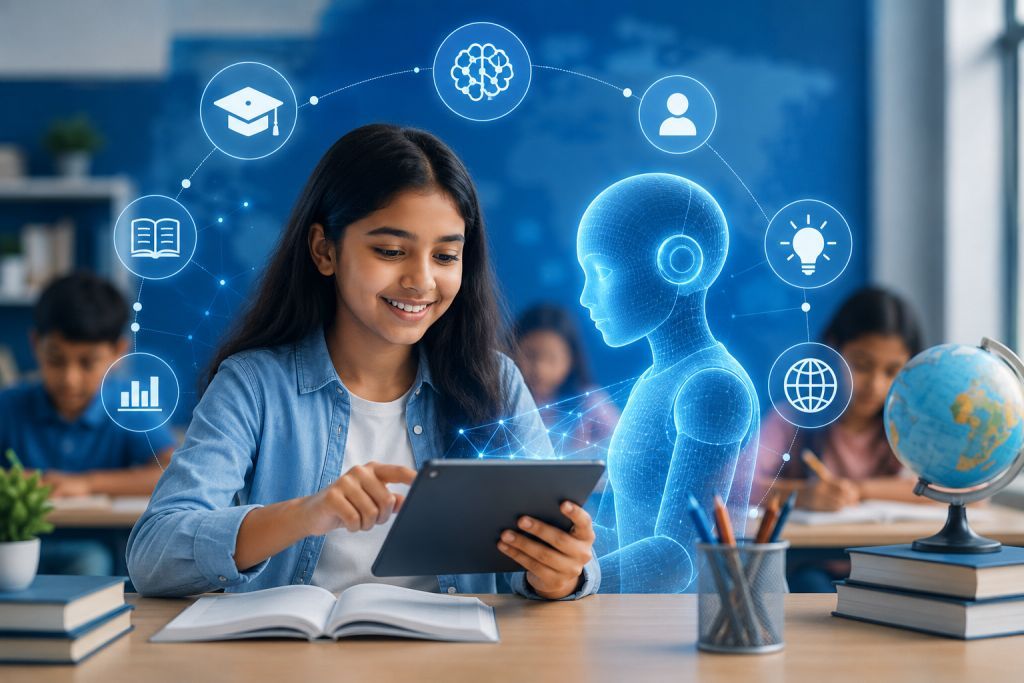
Artificial Intelligence (AI) is transforming education by making learning more personalized, accessible, and efficient for students, teachers, and educational institutions. From intelligent tutoring systems and AI-powered learning assistants to automated grading and personalized study recommendations, AI is changing how knowledge is delivered and how students engage with educational content.
Unlike traditional classroom models that often provide the same learning experience for every student, AI can adapt to individual learning styles, strengths, and challenges. Students who need additional support can receive personalized explanations, while advanced learners can move ahead at their own pace. This flexibility helps create more inclusive learning environments where every student has greater opportunities to succeed.
Teachers also benefit from AI by reducing repetitive administrative work such as grading quizzes, organizing lesson materials, tracking student progress, and generating reports. By automating routine tasks, educators can devote more time to teaching, mentoring, and supporting students.
At the same time, responsible AI use remains important. AI should enhance education rather than replace teachers, critical thinking, or independent learning. Students should continue developing problem-solving skills while using AI as a supportive educational tool.
This guide explores the major benefits of AI in education, explains how it is transforming classrooms in 2026, and highlights best practices for using AI responsibly to improve learning outcomes.
Quick Answer: What Are the Benefits of AI in Education?
AI benefits education by providing personalized learning, instant feedback, intelligent tutoring, improved accessibility, automated administrative tasks, better student engagement, data-driven insights, and flexible learning opportunities. It helps students learn at their own pace while supporting teachers with grading, lesson planning, and progress tracking. When used responsibly, AI enhances learning without replacing educators or independent thinking.
What Is AI in Education?
AI in education refers to the use of Artificial Intelligence technologies to improve teaching, learning, assessment, and educational administration. AI systems analyze information, recognize learning patterns, answer questions, generate educational content, and provide personalized recommendations that help students achieve better learning outcomes.
Examples of AI in education include:
- AI tutoring systems.
- Virtual learning assistants.
- Personalized learning platforms.
- Automatic grading tools.
- Language translation systems.
- Speech recognition software.
- Learning analytics dashboards.
These technologies support both classroom instruction and independent learning.
Why AI Is Transforming Education in 2026
Several factors have accelerated AI adoption across schools, colleges, universities, and online learning platforms.
- Growth of digital learning.
- Demand for personalized education.
- Expansion of online and hybrid classrooms.
- Improved AI-powered educational tools.
- Greater need for flexible learning experiences.
- Increasing availability of learning analytics.
- Growing demand for lifelong learning.
AI enables educational institutions to deliver learning experiences that are more responsive to individual student needs while improving efficiency for educators.
1. Personalized Learning
One of the greatest benefits of AI is its ability to personalize education. Every student learns differently, and AI systems can adjust learning materials based on progress, performance, and preferred learning pace.
Personalized learning includes:
- Customized lesson recommendations.
- Adaptive quizzes.
- Individual learning paths.
- Difficulty adjustments.
- Targeted revision suggestions.
- Progress monitoring.
This allows students to spend more time strengthening weaker areas while progressing more quickly through topics they already understand.
2. 24/7 Learning Assistance
Unlike traditional classroom support that may only be available during school hours, AI learning assistants are available at any time.
Students can:
- Ask questions after class.
- Review difficult concepts.
- Practice homework.
- Generate quizzes.
- Receive explanations.
- Create study schedules.
This continuous availability supports independent learning and helps students study more confidently.
3. Instant Feedback
Receiving immediate feedback helps students identify mistakes before they become long-term learning problems.
AI can provide:
- Quiz results instantly.
- Grammar corrections.
- Coding feedback.
- Writing suggestions.
- Practice recommendations.
- Performance tracking.
Timely feedback allows students to improve continuously without waiting for manual grading.
4. Improved Student Engagement
Interactive AI-powered learning experiences often make education more engaging than passive reading or lectures alone.
AI can increase engagement through:
- Interactive conversations.
- Gamified learning.
- Personalized challenges.
- Adaptive quizzes.
- Virtual tutors.
- Real-time guidance.
Greater engagement often leads to improved motivation and better knowledge retention.
5. Better Accessibility
AI helps make education more inclusive by supporting students with different learning needs, disabilities, and language backgrounds.
Accessibility features include:
- Text-to-speech.
- Speech-to-text.
- Automatic captions.
- Language translation.
- Reading assistance.
- Personalized accommodations.
These tools help reduce learning barriers and improve educational opportunities for diverse learners.
6. Administrative Automation
Teachers spend significant time on administrative work that reduces the time available for direct instruction.
AI can automate:
- Grading quizzes.
- Attendance tracking.
- Scheduling.
- Report generation.
- Assignment organization.
- Learning analytics.
Automation enables educators to focus more on teaching, mentoring, and student engagement.
7. Data-Driven Learning Insights
AI systems can analyze student performance to identify learning patterns and provide valuable insights.
These insights help educators:
- Identify struggling students.
- Monitor progress.
- Measure learning outcomes.
- Adjust lesson plans.
- Recommend interventions.
- Support continuous improvement.
Using educational data responsibly helps schools make informed decisions that improve student success.
8. AI-Powered Tutoring
AI tutors provide personalized assistance by answering questions, explaining concepts, generating examples, and guiding independent practice.
Students can use AI tutors to:
- Understand homework.
- Review lessons.
- Practice exam questions.
- Improve writing.
- Learn programming.
- Study foreign languages.
Although AI tutors offer valuable support, they work best alongside teachers, textbooks, and independent learning.
Responsible Use of AI in Education
Maximizing the benefits of AI requires responsible use by students, teachers, and educational institutions.
Best practices include:
- Using AI to support—not replace—learning.
- Verifying important information with reliable educational sources.
- Following academic integrity policies.
- Protecting student privacy and personal data.
- Developing critical thinking instead of relying solely on AI-generated responses.
- Balancing AI assistance with classroom instruction and independent practice.
When used ethically and thoughtfully, Artificial Intelligence becomes a powerful educational partner that enhances teaching, supports personalized learning, improves accessibility, and prepares students for a future where AI will play an increasingly important role in education and the workplace.
Comparison of AI Benefits in Education
| AI Benefit | How It Helps | Impact Level |
|---|---|---|
| Personalized Learning | Adapts lessons to each student's pace and ability | Very High |
| AI Tutoring | Provides instant explanations and learning support | Very High |
| Automated Grading | Reduces teacher workload and speeds feedback | High |
| Accessibility | Supports diverse learning needs and disabilities | Very High |
| Learning Analytics | Tracks progress and identifies learning gaps | High |
| Student Engagement | Creates interactive learning experiences | High |
| Administrative Automation | Handles repetitive educational tasks | High |
| 24/7 Learning Support | Allows students to learn anytime | Very High |
Applications of AI in Education
| Application | Purpose |
|---|---|
| AI Tutors | Personalized academic assistance |
| Chatbots | Answer student questions instantly |
| Adaptive Learning Platforms | Customize lessons based on student progress |
| Automatic Grading | Evaluate quizzes and assignments |
| Language Translation | Support multilingual learning |
| Speech Recognition | Convert speech into text for accessibility |
| Learning Analytics | Monitor student performance |
| Content Generation | Create quizzes, summaries, and study materials |
AI vs Traditional Learning
| Feature | AI-Powered Learning | Traditional Learning |
|---|---|---|
| Learning Pace | Personalized | Usually standardized |
| Availability | 24/7 | Limited by school hours |
| Feedback Speed | Immediate | Often delayed |
| Lesson Adaptation | Automatically adjusts difficulty | Limited personalization |
| Teacher Interaction | Supplementary | Primary source of guidance |
| Administrative Tasks | Highly automated | Mostly manual |
| Learning Analytics | Real-time insights | Periodic assessments |
Benefits of AI in Education
| Benefit | Description |
|---|---|
| Better Learning Outcomes | Personalized instruction helps students understand concepts more effectively. |
| Time Savings | Automates repetitive administrative tasks for teachers. |
| Improved Accessibility | Supports students with different learning needs. |
| Continuous Learning | Provides educational assistance beyond classroom hours. |
| Higher Engagement | Interactive tools increase motivation and participation. |
| Data-Driven Decisions | Helps educators identify learning gaps and improve teaching strategies. |
Advantages and Challenges
| Advantages | Challenges |
|---|---|
| Personalized education | Requires responsible AI use |
| 24/7 learning support | Information should be verified |
| Improved accessibility | Digital access may vary |
| Reduces teacher workload | Privacy and data protection concerns |
| Immediate feedback | Risk of overdependence on AI |
| Supports lifelong learning | Cannot replace human teachers |
Tips for Students and Teachers Using AI
Use AI as a Learning Assistant
Students should use AI to understand concepts, generate practice questions, organize study schedules, and receive feedback rather than simply obtaining answers.
Verify Important Information
Teachers and students should compare AI-generated information with textbooks, peer-reviewed sources, and trusted educational materials.
Encourage Critical Thinking
Students should evaluate AI responses, ask follow-up questions, and develop independent reasoning instead of accepting every answer automatically.
Balance AI with Human Interaction
AI complements classroom teaching but does not replace discussions, mentoring, collaboration, or teacher guidance.
Protect Privacy
Educational institutions and students should avoid sharing sensitive personal information and follow appropriate data privacy practices when using AI platforms.
The Future of AI in Education
More Personalized Learning
Future AI systems are expected to provide even more adaptive learning experiences by continuously adjusting lessons based on student progress and learning preferences.
Smarter Virtual Tutors
AI tutors will likely become more interactive, offering personalized explanations, simulations, and real-time coaching across many academic subjects.
Greater Accessibility
Advances in translation, speech recognition, and assistive technologies are expected to make education more inclusive for learners with diverse backgrounds and abilities.
Teacher Empowerment
Rather than replacing educators, AI is expected to automate administrative work and provide insights that help teachers deliver more effective instruction.
Lifelong Learning
AI-powered educational platforms will continue supporting learners throughout their careers as industries evolve and new skills become necessary.
Featured Snippet: What Are the Benefits of AI in Education?
Artificial Intelligence improves education by personalizing learning, providing instant feedback, supporting teachers, increasing accessibility, automating repetitive tasks, enhancing student engagement, and delivering 24/7 learning assistance. AI helps students learn at their own pace while allowing educators to focus more on teaching and mentoring. When used responsibly, AI enhances education without replacing teachers or independent learning.
Frequently Asked Questions
1. What is AI in education?
AI in education refers to the use of Artificial Intelligence technologies to improve teaching, learning, assessment, accessibility, and educational administration.
2. Can AI replace teachers?
No. AI supports teachers by automating repetitive tasks and providing additional learning resources, but human instruction, mentorship, and classroom interaction remain essential.
3. How does AI personalize learning?
AI analyzes student performance and adjusts lessons, practice activities, and recommendations according to individual learning needs.
4. Is AI useful for students?
Yes. AI helps students understand concepts, receive instant feedback, organize study schedules, practice skills, and prepare for exams.
5. How does AI improve accessibility?
AI offers text-to-speech, speech recognition, translation, captions, and personalized learning support for diverse learners.
6. Can AI improve student engagement?
Yes. Interactive lessons, personalized challenges, and AI-powered tutoring can increase motivation and participation.
7. Does AI save teachers time?
Yes. AI automates grading, attendance tracking, report generation, scheduling, and other repetitive administrative tasks.
8. Is AI available outside classroom hours?
Yes. Many AI educational tools provide learning assistance at any time, allowing students to study whenever needed.
9. Can AI help with homework?
Yes. AI can explain concepts, guide problem-solving, summarize lessons, and generate practice questions while encouraging independent learning.
10. Is AI good for online learning?
Yes. AI supports adaptive learning, personalized feedback, and interactive experiences that enhance online education.
11. What are learning analytics?
Learning analytics use educational data to identify progress, strengths, weaknesses, and opportunities for improvement.
12. Can AI generate educational content?
Yes. AI can create quizzes, summaries, lesson plans, flashcards, and study guides that support teaching and learning.
13. What are the biggest challenges of AI in education?
Challenges include data privacy, responsible use, verifying information, equitable access, and avoiding excessive dependence on AI.
14. Should students verify AI-generated information?
Yes. Important academic information should always be confirmed using trusted educational sources and teacher guidance.
15. Is AI useful for lifelong learning?
Yes. AI supports continuous education by helping learners acquire new skills throughout their personal and professional lives.
16. How should schools implement AI?
Schools should combine AI with teacher expertise, establish clear usage guidelines, protect student privacy, and promote ethical AI practices.
17. What is the future of AI in education?
AI is expected to deliver increasingly personalized learning, smarter tutoring systems, improved accessibility, better analytics, and stronger support for lifelong learning while continuing to complement human educators.
Summary
Artificial Intelligence is reshaping education by making learning more personalized, accessible, and efficient. AI-powered tutoring, adaptive learning platforms, automated grading, learning analytics, and accessibility tools help students receive individualized support while reducing administrative workloads for teachers. These technologies encourage greater engagement, provide immediate feedback, and enable students to learn at their own pace regardless of time or location.
Despite its many advantages, AI should be viewed as a tool that enhances—not replaces—quality teaching and independent learning. Teachers remain essential for mentorship, creativity, emotional support, and critical thinking development. By combining AI with evidence-based teaching practices, responsible data use, and strong academic integrity, educational institutions can create more effective, inclusive, and future-ready learning environments that prepare students for success in an increasingly digital world.
Sources
- UNESCO – Artificial Intelligence in Education
- OECD – Education and Skills
- OpenAI – Research
- Microsoft Learn – AI and Education
- Edutopia – Teaching and Learning Strategies
- American Psychological Association – Learning Resources
- The Learning Scientists – Evidence-Based Learning Strategies
- Grow with Google – Education and Digital Skills
- Coursera – AI in Education
- European Commission – Digital Education Resources