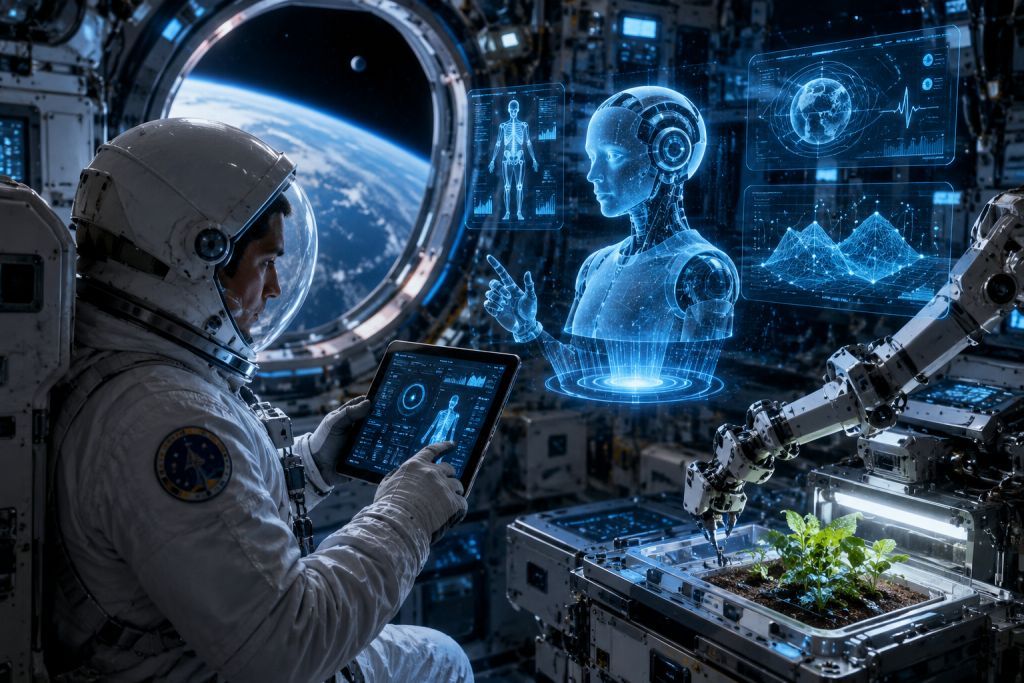
Artificial Intelligence (AI) is becoming one of the most important technologies in modern space exploration. As missions travel farther from Earth and become more complex, astronauts must manage enormous amounts of information while operating in one of the most challenging environments known to humanity. AI helps by processing data quickly, supporting decision-making, automating routine tasks, assisting with scientific experiments, and improving mission safety.
Space agencies and private aerospace companies are increasingly integrating AI into spacecraft, satellites, robotic systems, and mission planning. Whether analyzing images captured by space telescopes, monitoring astronaut health, optimizing spacecraft trajectories, or helping robotic explorers navigate distant planets, AI is already contributing to many aspects of space missions.
Future missions to the Moon, Mars, and beyond will involve longer travel times and communication delays that make continuous guidance from Earth more difficult. In these situations, AI can act as an intelligent assistant, helping astronauts respond to unexpected situations while allowing mission control to focus on broader strategic decisions.
Although AI is becoming more capable every year, it is designed to complement—not replace—astronauts. Human experience, judgment, teamwork, creativity, and adaptability remain essential for successful space exploration.
This guide explains how Artificial Intelligence is helping astronauts today and how it may shape the future of human space exploration.
Quick Answer: How Will AI Help Astronauts?
Artificial Intelligence helps astronauts by supporting mission planning, autonomous spacecraft navigation, robotic assistance, health monitoring, scientific research, equipment maintenance, communication management, and emergency response. AI analyzes large amounts of mission data, automates repetitive tasks, predicts equipment failures, assists with medical monitoring, and helps astronauts make informed decisions—especially during long-duration missions where communication with Earth may be delayed.
How Artificial Intelligence Is Transforming Space Exploration
Space missions generate enormous volumes of information from spacecraft systems, onboard sensors, scientific instruments, satellites, and astronaut activities. Processing all of this information manually can be time-consuming and may delay important decisions.
Artificial Intelligence enables spacecraft and mission teams to analyze complex data more efficiently, recognize patterns, detect anomalies, and recommend actions. As AI technology continues to improve, it is expected to play an even greater role in planning, operating, and supporting future missions beyond Earth.
Modern AI applications in space include:
- Autonomous spacecraft operations
- Robotic exploration
- Astronaut health monitoring
- Mission planning optimization
- Satellite data analysis
- Scientific discovery
- Predictive maintenance
- Navigation assistance
Why Astronauts Need Artificial Intelligence
Space presents unique challenges that differ significantly from conditions on Earth. Astronauts must operate in environments where resources are limited, communication delays may occur, and immediate assistance from Earth is not always available.
AI helps astronauts by reducing workload and providing intelligent support in situations where quick analysis or autonomous decision-making is beneficial.
Some reasons astronauts benefit from AI include:
- Managing complex spacecraft systems
- Monitoring life-support equipment
- Analyzing scientific experiments
- Supporting navigation
- Improving mission safety
- Reducing repetitive manual tasks
- Assisting during emergencies
How AI Assists Before, During, and After Space Missions
Before Launch
AI supports engineers and mission planners by analyzing simulations, optimizing spacecraft design, evaluating weather conditions, and helping prepare mission timelines. It can also identify potential risks before launch through predictive analysis of engineering data.
During the Mission
While astronauts are in space, AI monitors spacecraft systems, assists with navigation, tracks environmental conditions, supports onboard experiments, and helps prioritize operational tasks.
After Mission Completion
Following a mission, AI assists scientists by analyzing collected data, organizing mission records, identifying research patterns, and improving planning for future space exploration.
AI-Powered Spacecraft Navigation
Navigation becomes increasingly challenging during long-distance space missions. Spacecraft must account for orbital mechanics, fuel efficiency, gravitational influences, and unexpected environmental conditions.
AI assists navigation by:
- Optimizing flight paths
- Monitoring spacecraft position
- Supporting autonomous maneuvering
- Detecting navigation anomalies
- Reducing fuel consumption where possible
- Improving landing precision
Autonomous navigation becomes especially valuable for deep-space missions where communication with Earth may involve significant delays.
AI for Mission Planning
Planning a space mission involves coordinating thousands of interconnected activities. AI helps mission planners evaluate numerous variables more efficiently than traditional manual approaches.
AI may assist with:
- Crew scheduling
- Scientific experiment planning
- Power management
- Resource allocation
- Cargo organization
- Risk assessment
- Mission timeline optimization
These capabilities allow mission teams to evaluate multiple scenarios and prepare for changing mission conditions.
AI in Robotics and Autonomous Systems
Robots are becoming increasingly important partners for astronauts. AI-powered robotic systems can perform tasks that may be dangerous, repetitive, or physically demanding.
Examples include:
- Equipment inspection
- External spacecraft maintenance
- Sample collection
- Cargo transportation
- Surface exploration
- Construction assistance
Future robotic assistants may work alongside astronauts on lunar and Martian missions, reducing physical workload and improving operational efficiency.
AI for Astronaut Health Monitoring
Maintaining astronaut health during long-duration missions is essential. AI can help monitor physiological information collected from medical devices and onboard sensors.
Potential applications include:
- Heart rate monitoring
- Sleep pattern analysis
- Exercise tracking
- Stress assessment
- Nutritional monitoring
- Medical data analysis
AI can also help identify unusual patterns that may warrant further evaluation by astronauts or medical teams on Earth.
AI for Communication and Decision Support
As missions travel farther into space, communication delays become more significant. Signals between Earth and Mars, for example, can take several minutes each way depending on planetary positions.
AI can assist astronauts by:
- Organizing mission information
- Prioritizing alerts
- Summarizing technical data
- Supporting operational decisions
- Answering onboard procedural questions
- Providing intelligent digital assistance
Rather than waiting for instructions from Earth, astronauts may receive AI-supported recommendations while maintaining human oversight over important mission decisions.
AI in Scientific Research During Space Missions
Space missions conduct a wide range of scientific experiments involving biology, physics, astronomy, materials science, and planetary geology.
AI helps researchers by:
- Analyzing experimental data
- Identifying patterns in observations
- Processing images from telescopes and planetary instruments
- Detecting unusual scientific events
- Organizing research findings
These capabilities allow astronauts and scientists to spend more time interpreting results and planning new experiments rather than manually processing large datasets.
AI for Emergency Response in Space
Although space missions are carefully planned, unexpected situations can still occur. Equipment malfunctions, environmental hazards, or medical emergencies require rapid assessment and coordinated responses.
AI can support emergency preparedness by:
- Monitoring spacecraft systems continuously
- Detecting abnormal equipment behavior
- Providing troubleshooting recommendations
- Prioritizing system alerts
- Supporting emergency procedures
- Helping evaluate possible response options
By identifying potential problems early and organizing critical information, AI can help astronauts respond more effectively while mission control remains involved whenever communication is available.
How AI Helps Astronauts Throughout a Space Mission
| Mission Phase | AI Assistance |
|---|---|
| Mission Planning | Optimizes schedules, predicts risks, and analyzes mission simulations. |
| Launch | Monitors spacecraft systems and assists engineers with real-time diagnostics. |
| Space Travel | Supports autonomous navigation, resource management, and equipment monitoring. |
| Scientific Research | Processes experiment data and identifies important findings faster. |
| Planetary Exploration | Guides robotic assistants, analyzes terrain, and assists navigation. |
| Return Mission | Monitors spacecraft health, landing systems, and mission performance. |
Major AI Applications in Space Exploration
| Application | How It Helps Astronauts |
|---|---|
| Autonomous Navigation | Calculates efficient flight paths and supports spacecraft maneuvering. |
| Space Robotics | Performs hazardous inspections, repairs, and sample collection. |
| Health Monitoring | Tracks astronaut health using wearable sensors and onboard medical systems. |
| Mission Planning | Optimizes schedules, resources, and scientific activities. |
| Predictive Maintenance | Detects equipment problems before failures occur. |
| Scientific Analysis | Processes images, geological samples, and research data. |
| Communication Support | Organizes information and assists with onboard decision-making. |
| Emergency Response | Prioritizes alerts and recommends troubleshooting procedures. |
Benefits of AI for Astronauts
| Benefit | Description |
|---|---|
| Improved Safety | Monitors spacecraft systems continuously to identify potential issues. |
| Reduced Workload | Automates repetitive operational tasks. |
| Better Decision Support | Analyzes large datasets quickly to assist astronauts. |
| Faster Scientific Research | Processes experimental data efficiently. |
| Resource Optimization | Helps manage power, oxygen, water, and supplies. |
| Autonomous Operations | Supports missions where communication delays limit real-time guidance. |
| Mission Efficiency | Improves planning, scheduling, and operational performance. |
Advantages and Challenges of AI in Space
| Advantages | Challenges |
|---|---|
| Supports astronaut safety | Requires extensive testing and validation |
| Processes massive amounts of data quickly | Must operate reliably in harsh space environments |
| Improves mission efficiency | Limited computing resources onboard spacecraft |
| Enables autonomous decision support | Cybersecurity and software reliability concerns |
| Reduces routine workload | Requires human oversight for critical decisions |
| Supports long-duration missions | Complex system integration |
Future AI Technologies for Moon and Mars Missions
Future human missions to the Moon and Mars are expected to rely heavily on Artificial Intelligence because astronauts will operate farther from Earth than ever before.
Potential future AI capabilities include:
- Autonomous habitat management
- AI-powered scientific laboratories
- Intelligent construction robots
- Resource discovery and extraction assistance
- Advanced medical diagnostic support
- Personal AI assistants for astronauts
- Autonomous exploration vehicles
- Intelligent environmental monitoring
These technologies could help crews remain productive and safe during missions lasting months or even years.
Common Myths About AI in Space Exploration
AI Will Replace Astronauts
No. AI is designed to assist astronauts by handling repetitive, data-intensive, or hazardous tasks. Human expertise, judgment, creativity, and teamwork remain essential for space exploration.
AI Can Completely Control Space Missions
Although AI can support autonomous operations, mission control and astronauts continue to supervise critical decisions and overall mission objectives.
AI Never Makes Mistakes
Like any software system, AI can produce incorrect recommendations or encounter unexpected situations. Careful testing, validation, and human oversight remain important.
Only Future Missions Will Use AI
AI is already used today in satellite operations, spacecraft navigation, scientific data analysis, mission planning, robotics, and equipment monitoring.
AI Makes Human Training Unnecessary
Astronauts still undergo extensive training because they must understand spacecraft systems, perform repairs, respond to emergencies, and evaluate AI recommendations.
Featured Snippet: How Will AI Help Astronauts?
Artificial Intelligence helps astronauts by improving mission planning, autonomous spacecraft navigation, robotic assistance, health monitoring, scientific research, predictive maintenance, communication support, and emergency response. AI analyzes mission data, automates routine tasks, monitors spacecraft systems, detects potential equipment failures, assists with medical monitoring, and helps astronauts make informed decisions during long-duration space missions where communication with Earth may be delayed.
Frequently Asked Questions
1. How does AI help astronauts?
AI assists with navigation, health monitoring, robotics, mission planning, scientific analysis, equipment monitoring, and decision support.
2. Can AI fly a spacecraft?
AI can assist with autonomous navigation and flight operations, while astronauts and mission control continue to oversee critical decisions.
3. Why is AI useful on Mars missions?
Communication delays between Earth and Mars make autonomous assistance valuable for navigation, diagnostics, and operational decision support.
4. Can AI monitor astronaut health?
Yes. AI can analyze health data collected from medical devices and wearable sensors to help identify patterns that may require attention.
5. Will robots replace astronauts?
No. Robots and AI are expected to work alongside astronauts by performing tasks that are repetitive, hazardous, or physically demanding.
6. How does AI improve spacecraft safety?
AI continuously monitors onboard systems, detects anomalies, and supports preventive maintenance and troubleshooting.
7. Can AI repair spacecraft?
AI can assist robotic systems and astronauts during maintenance, but repairs typically involve human supervision or direct astronaut involvement.
8. Does NASA use AI?
Yes. NASA and many other space organizations use AI for mission planning, scientific research, autonomous systems, robotics, and data analysis.
9. Can AI help discover new planets?
AI helps scientists analyze large astronomical datasets, making it easier to identify patterns and potential discoveries.
10. How does AI support scientific experiments?
AI processes research data, detects trends, and assists scientists in interpreting experimental results.
11. Can AI predict equipment failures?
Yes. Predictive maintenance systems analyze equipment performance to identify signs of potential failures before they become critical.
12. Will AI be important for lunar bases?
Yes. AI is expected to help manage habitats, resources, power systems, scientific research, and robotic operations on future lunar bases.
13. How does AI reduce astronaut workload?
By automating repetitive tasks, organizing information, monitoring systems, and assisting with data analysis.
14. Is AI used in satellites?
Yes. AI supports satellite navigation, image processing, Earth observation, communications, and system monitoring.
15. Can AI operate without communication from Earth?
Many AI systems can perform certain autonomous functions, which is particularly useful during missions with communication delays.
16. What is the biggest advantage of AI in space?
Its ability to rapidly analyze information, automate complex tasks, and support astronauts in challenging environments.
17. What is the future of AI in space exploration?
Future AI is expected to support autonomous habitats, intelligent robotics, advanced medical systems, resource management, and deep-space exploration to the Moon, Mars, and beyond.
Summary
Artificial Intelligence is becoming an essential partner in human space exploration. By supporting navigation, mission planning, robotics, scientific research, health monitoring, predictive maintenance, and emergency response, AI helps astronauts work more safely and efficiently in some of the most demanding environments imaginable. Rather than replacing astronauts, AI complements human expertise by processing large amounts of information and assisting with routine or complex tasks.
As humanity prepares for longer missions to the Moon, Mars, and eventually deeper into the solar system, AI is expected to become even more important. Intelligent spacecraft, autonomous robotic assistants, smart habitats, and advanced decision-support systems will help astronauts overcome the challenges of deep-space exploration while enabling new scientific discoveries and expanding our understanding of the universe.
Sources
- NASA – Artificial Intelligence
- NASA Science – Space Exploration Research
- European Space Agency – Space Technology
- NASA Jet Propulsion Laboratory – Robotics and AI
- NASA – Humans in Space
- NASA – Artemis Program
- NASA – Mars Exploration Program
- Nature – Artificial Intelligence Research
- IEEE Xplore – Artificial Intelligence and Space Systems
- Space.com – AI and Space Exploration News