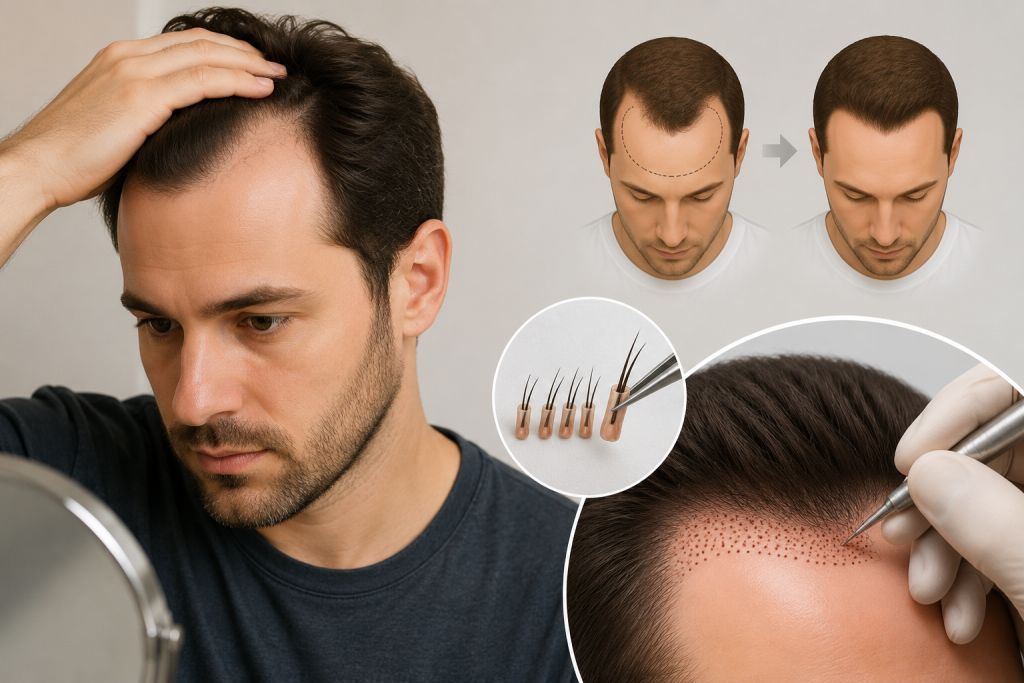
A receding hairline is one of the most common forms of hair loss among men, although it can also affect women. As the hairline gradually moves backward, many people begin exploring hair restoration options, including hair transplant surgery.
One of the first questions patients ask during a consultation is: How many grafts do I need for a receding hairline?
The answer depends on several factors, including the severity of hairline recession, the desired density, the size of the treatment area, donor hair availability, and long-term hair loss patterns.
While some patients may need only 800–1,200 grafts for minor temple recession, others may require 2,000–3,000 grafts or more for advanced hairline restoration.
This guide explains how graft requirements are estimated, what affects the final graft count, and what patients should expect during hair transplant planning.
Quick Answer
Most patients with a receding hairline typically require:
- 800–1,200 grafts for mild recession
- 1,200–2,000 grafts for moderate recession
- 2,000–3,000+ grafts for advanced hairline restoration
However, the exact number depends on individual anatomy, hair characteristics, and treatment goals. A professional consultation is necessary for an accurate estimate.
Key Facts
- One graft typically contains 1–4 hairs.
- Hairline restoration often requires fewer grafts than crown restoration.
- Hair density goals affect graft requirements.
- Hair thickness influences visual coverage.
- Donor hair availability limits the number of grafts that can be harvested.
- Long-term hair loss planning is important when designing a new hairline.
What Is a Hair Graft?
A hair graft is a naturally occurring group of hair follicles removed from the donor area and transplanted into thinning or bald regions.
Each graft may contain:
- 1 hair
- 2 hairs
- 3 hairs
- 4 hairs
Hair transplant surgeons strategically place grafts to create natural-looking density and hairline design.
Why Graft Count Matters
The number of grafts used during a procedure significantly affects the final result.
Proper graft planning helps achieve:
- Natural hairline appearance
- Adequate density
- Balanced facial proportions
- Long-term aesthetic outcomes
- Efficient donor area management
Using too few grafts may lead to insufficient coverage, while poor planning may unnecessarily deplete donor hair reserves.
How Surgeons Estimate Graft Requirements
Hair transplant specialists evaluate several factors when calculating graft needs.
These include:
- Size of the bald area
- Degree of recession
- Hair shaft thickness
- Hair color and scalp contrast
- Desired density
- Age
- Future hair loss risk
- Donor area quality
Every patient receives an individualized treatment plan.
Understanding the Norwood Scale
The Norwood Scale is commonly used to classify male pattern hair loss.
As the Norwood stage increases, graft requirements often increase as well.
Norwood Scale vs Estimated Graft Requirements
| Norwood Stage | Description | Estimated Grafts |
|---|---|---|
| Norwood 2 | Mild temple recession | 800–1,200 |
| Norwood 3 | Moderate recession | 1,200–1,800 |
| Norwood 3 Vertex | Hairline and crown involvement | 1,500–2,500 |
| Norwood 4 | Advanced recession | 2,000–3,000 |
| Norwood 5+ | Extensive loss | 3,000–5,000+ |
These numbers are approximate and vary among patients.
How Many Grafts for Mild Receding Hairlines?
Patients with minor temple recession often require fewer grafts.
Typical range:
- 800–1,200 grafts
This amount may restore:
- Temple points
- Minor frontal recession
- Early hairline changes
Patients in this category usually have strong donor areas and minimal overall hair loss.
How Many Grafts for Moderate Receding Hairlines?
Moderate hairline recession generally requires more extensive coverage.
Typical range:
- 1,200–2,000 grafts
This often includes:
- Hairline reconstruction
- Temple filling
- Improved frontal density
Many patients seeking cosmetic hairline improvement fall within this category.
How Many Grafts for Severe Receding Hairlines?
Advanced recession usually requires larger graft counts.
Typical range:
- 2,000–3,000+ grafts
In severe cases, treatment may involve:
- Extensive frontal restoration
- Hairline advancement
- Large treatment areas
Long-term planning becomes especially important for advanced hair loss.
Hairline Graft Calculator Guide
| Hairline Condition | Estimated Grafts |
|---|---|
| Minor recession | 800–1,200 |
| Moderate recession | 1,200–2,000 |
| Advanced recession | 2,000–3,000+ |
| Hairline plus frontal zone | 2,000–3,500 |
| Hairline, frontal zone, and crown | 3,000–5,000+ |
Why Hair Characteristics Matter
Not all patients require the same graft count for similar hair loss patterns.
Hair characteristics influence visual coverage.
Factors include:
- Hair thickness
- Hair curl
- Hair color
- Scalp color
- Hair density
Thicker or curlier hair often creates greater visual coverage using fewer grafts.
Hairline Design Considerations
Modern hair transplantation focuses on natural-looking hairlines rather than simply maximizing density.
Surgeons consider:
- Facial proportions
- Age
- Ethnicity
- Future hair loss progression
- Patient expectations
A conservative and natural design often ages better over time.
Hair Transplant Statistics and Industry Insights
Hair transplantation continues to grow in popularity as techniques become more advanced and natural-looking results become increasingly achievable.
- Hairline restoration is one of the most commonly requested hair transplant procedures.
- Many patients seeking treatment for a receding hairline require between 1,000 and 2,500 grafts.
- FUE and FUT remain the most widely performed hair transplant techniques.
- Hair density and donor hair quality significantly influence treatment planning.
- Final results generally continue improving for 12–18 months after surgery.
Modern hair restoration focuses on creating natural density while preserving donor hair for future needs.
Factors That Affect Graft Requirements
The number of grafts needed for a receding hairline varies considerably between individuals.
1. Size of the Receding Area
Larger treatment areas require more grafts to achieve adequate coverage.
2. Desired Density
Patients seeking maximum density generally require more grafts than those seeking moderate coverage.
3. Hair Thickness
Thicker hair shafts provide greater visual coverage and may reduce graft requirements.
4. Hair Color and Scalp Contrast
Hair that closely matches scalp color often creates the appearance of greater density.
5. Donor Area Availability
The number of available donor grafts limits how aggressively surgeons can restore the hairline.
6. Future Hair Loss Risk
Long-term planning helps ensure donor reserves remain available if additional procedures become necessary.
FUE vs FUT Graft Planning Comparison
| Factor | FUE | FUT |
|---|---|---|
| Harvesting Method | Individual follicle extraction | Strip removal technique |
| Linear Scar | No | Yes |
| Recovery Time | Generally shorter | Generally longer |
| Large Graft Sessions | Possible | Often efficient for larger sessions |
| Short Hairstyles | Often preferred | May limit very short styles |
Both procedures can produce excellent hairline restoration results when performed appropriately.
Benefits of Lower Graft Counts (800–1,500 Grafts)
Smaller procedures may be suitable for patients with mild recession.
Potential advantages include:
- Less donor hair usage
- Lower overall procedure cost
- Shorter procedure time
- Preservation of future donor reserves
- Natural enhancement of the hairline
However, coverage may be limited if hair loss progresses significantly.
Benefits of Moderate Graft Counts (1,500–2,500 Grafts)
This range is common for moderate hairline restoration.
Potential advantages include:
- Improved density
- Enhanced hairline shape
- Greater cosmetic impact
- Balanced donor management
Many surgeons consider this range ideal for moderate frontal restoration.
Benefits of Higher Graft Counts (2,500–4,000+ Grafts)
Larger procedures are often used for advanced recession.
Potential advantages include:
- Extensive coverage
- Significant density improvement
- Treatment of larger bald areas
- Comprehensive frontal restoration
However, larger sessions require careful donor area management.
Common Mistakes Patients Make When Estimating Grafts
Many patients underestimate the complexity of hair transplant planning.
Common mistakes include:
- Focusing only on graft count
- Ignoring donor limitations
- Seeking an unnaturally low hairline
- Overlooking future hair loss
- Comparing results directly with others
Successful restoration depends on multiple factors beyond graft numbers alone.
Can You Lower Your Hairline Significantly?
While some degree of hairline lowering is possible, surgeons often avoid creating extremely low hairlines.
Reasons include:
- Natural appearance concerns
- Future hair loss planning
- Donor hair preservation
- Long-term aesthetic balance
A conservative approach often provides better long-term results.
When Should You Consult a Hair Transplant Surgeon?
Consider scheduling a consultation if you:
- Notice ongoing hairline recession
- Have stable hair loss patterns
- Want to explore restoration options
- Need a personalized graft estimate
- Want to discuss FUE or FUT procedures
A qualified surgeon can evaluate donor hair quality and provide individualized recommendations.
Pros and Cons of Hairline Hair Transplants
| Pros | Cons |
|---|---|
| Natural-looking results | Requires surgery |
| Long-lasting improvement | Can be expensive |
| Improved appearance for many patients | Recovery period required |
| Customizable hairline design | Results take time to develop |
| Permanent transplanted follicles | Future procedures may be needed |
Frequently Asked Questions
How many grafts do I need for a receding hairline?
Most patients require between 800 and 3,000 grafts depending on the severity of hairline recession and treatment goals.
Can 1,000 grafts restore a hairline?
For mild recession, 1,000 grafts may provide meaningful improvement.
Is 2,000 grafts enough for a receding hairline?
For many patients with moderate recession, 2,000 grafts can produce significant restoration.
How many hairs are in 2,000 grafts?
Because each graft may contain 1–4 hairs, 2,000 grafts often contain approximately 4,000–5,000 hairs.
Does thicker hair require fewer grafts?
Yes. Thicker hair often creates better visual coverage and may reduce graft requirements.
Can I restore my hairline and crown in one procedure?
In some cases, yes. However, the required graft count may increase substantially.
Will I need a second hair transplant later?
Some patients may choose additional procedures if future hair loss continues.
Summary
The number of grafts needed for a receding hairline depends on several factors, including the extent of hair loss, desired density, donor hair availability, and long-term restoration goals. Mild recession may require as few as 800–1,200 grafts, while moderate cases often need 1,200–2,000 grafts. Advanced hairline restoration may require 2,000–3,000 or more grafts. A professional consultation remains the most accurate way to determine individual graft requirements.
Conclusion
Hair transplant graft planning is both a science and an art. While online graft calculators and general estimates can provide a starting point, every patient has unique characteristics that influence treatment recommendations.
The best outcomes typically result from personalized planning that considers current hair loss, future hair loss risk, donor area limitations, and natural hairline design principles. Working with an experienced hair transplant surgeon can help ensure realistic expectations and long-term satisfaction with the results.
Sources
- International Society of Hair Restoration Surgery (ISHRS)
- American Academy of Dermatology (AAD)
- National Center for Biotechnology Information (NCBI)
- National Institutes of Health (NIH)
- MedlinePlus
- Cleveland Clinic
- Mayo Clinic
- Harvard Health Publishing
- National Institute of Arthritis and Musculoskeletal and Skin Diseases (NIAMS)
- U.S. Food and Drug Administration (FDA)