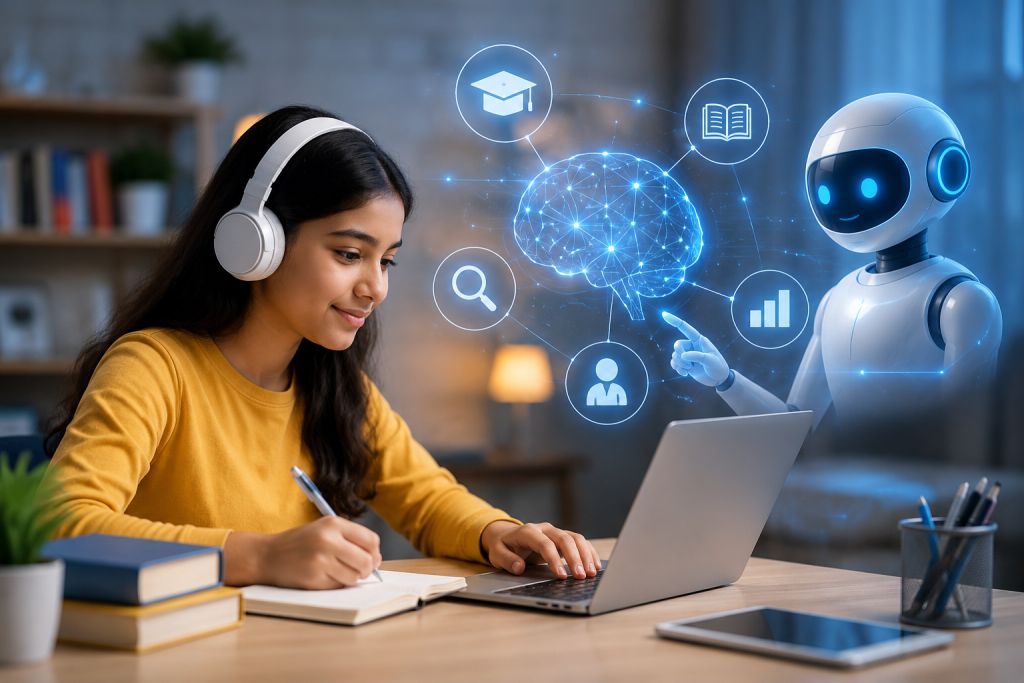
Artificial Intelligence (AI) is changing the way people learn by making education more personalized, interactive, and accessible than ever before. From AI-powered tutors and adaptive learning platforms to automated assessments and intelligent study assistants, AI helps students receive educational support that matches their individual learning needs. Instead of following a one-size-fits-all approach, modern AI systems can analyze student performance and recommend lessons, activities, and practice exercises that fit each learner's strengths and areas for improvement.
Learning is most effective when students receive timely feedback, engage with material at the right level of difficulty, and have opportunities to practice consistently. AI makes this possible by providing instant responses, personalized recommendations, and continuous learning support. Whether a student is learning mathematics, languages, programming, science, or business, AI tools can explain concepts, generate quizzes, summarize lessons, and offer customized study guidance.
Teachers also benefit from AI because it automates repetitive administrative work such as grading quizzes, tracking student progress, organizing lesson materials, and identifying learning gaps. This allows educators to spend more time mentoring students, encouraging creativity, and supporting deeper learning experiences.
Although AI offers significant educational advantages, it is most effective when combined with experienced teachers, independent study, and critical thinking. AI should enhance education rather than replace meaningful human interaction or the development of problem-solving skills.
This guide explores how Artificial Intelligence improves learning, the technologies driving educational innovation, and why AI is becoming an important part of modern education in 2026 and beyond.
Quick Answer: How Does Artificial Intelligence Improve Learning?
Artificial Intelligence improves learning by personalizing education, adapting lessons to each student's needs, providing instant feedback, offering intelligent tutoring, increasing accessibility, automating repetitive tasks, and helping students study more effectively. AI allows learners to progress at their own pace while supporting teachers with grading, lesson planning, and performance analysis, creating a more efficient and engaging educational experience.
What Is Artificial Intelligence in Learning?
Artificial Intelligence in learning refers to the use of AI technologies to improve education through intelligent software that supports teaching, studying, assessment, and student engagement. AI systems can analyze learning behavior, answer questions, generate educational content, recommend personalized study plans, and continuously adapt learning experiences based on student performance.
Common examples include:
- AI learning assistants.
- Adaptive learning platforms.
- Virtual tutors.
- Automatic grading systems.
- Language translation tools.
- Speech recognition software.
- Learning analytics dashboards.
These technologies help students receive individualized support while improving efficiency for educators.
How AI Is Transforming Education in 2026
Education is evolving rapidly as AI becomes integrated into classrooms, universities, online courses, and lifelong learning programs.
Major trends include:
- Personalized learning experiences.
- AI-powered tutoring.
- Adaptive assessments.
- Automated administrative tasks.
- Interactive digital learning.
- Improved accessibility.
- Continuous learning analytics.
These innovations help create educational experiences that are more flexible, efficient, and responsive to individual student needs.
1. Personalized Learning
Every student learns differently. Some grasp concepts quickly, while others need additional explanations and practice. AI analyzes learning patterns to provide personalized recommendations that match each learner's pace and ability.
Personalized learning includes:
- Customized lesson plans.
- Adaptive quizzes.
- Individual study recommendations.
- Progress tracking.
- Difficulty adjustments.
- Targeted revision exercises.
This individualized approach helps students focus on areas where they need the most improvement while avoiding unnecessary repetition.
2. Intelligent Tutoring Systems
AI-powered tutors provide students with immediate educational support whenever they need assistance.
These systems can:
- Explain difficult concepts.
- Answer academic questions.
- Generate examples.
- Create practice problems.
- Provide homework guidance.
- Support exam preparation.
Unlike traditional tutoring, AI tutors are available around the clock, allowing students to learn whenever they choose.
3. Instant Feedback
Quick feedback helps students identify mistakes before they become long-term learning problems.
AI provides:
- Immediate quiz results.
- Writing suggestions.
- Grammar corrections.
- Coding feedback.
- Problem-solving guidance.
- Performance recommendations.
Receiving immediate feedback encourages continuous improvement and strengthens learning outcomes.
4. Adaptive Learning Platforms
Adaptive learning platforms continuously adjust educational content based on student performance.
These systems can:
- Increase or decrease difficulty.
- Recommend additional practice.
- Identify knowledge gaps.
- Adjust lesson sequences.
- Monitor long-term progress.
- Create personalized revision plans.
This dynamic approach ensures students receive learning experiences appropriate for their current level of understanding.
5. Improved Student Engagement
Interactive AI tools often make studying more enjoyable by encouraging active participation rather than passive reading.
AI increases engagement through:
- Interactive conversations.
- Practice quizzes.
- Personalized challenges.
- Gamified learning activities.
- Real-time assistance.
- Adaptive educational content.
Higher engagement frequently leads to better motivation, stronger concentration, and improved knowledge retention.
6. Accessibility and Inclusive Learning
AI helps make education accessible to students with different abilities, languages, and learning preferences.
Accessibility features include:
- Text-to-speech.
- Speech-to-text.
- Automatic translation.
- Caption generation.
- Reading assistance.
- Personalized accommodations.
These technologies reduce learning barriers while supporting more inclusive educational environments.
7. AI-Powered Content Creation
Artificial Intelligence can generate educational resources that support both teachers and students.
Examples include:
- Study guides.
- Practice quizzes.
- Flashcards.
- Lesson summaries.
- Writing prompts.
- Revision notes.
These resources help students review information efficiently while allowing teachers to prepare learning materials more quickly.
Responsible Use of AI in Learning
To maximize educational benefits, AI should be used responsibly alongside traditional teaching methods.
Best practices include:
- Using AI to support—not replace—learning.
- Verifying important information using trusted academic sources.
- Following school and university AI policies.
- Protecting personal and educational data.
- Developing critical thinking alongside AI assistance.
- Balancing AI tools with teacher guidance and independent study.
When integrated thoughtfully, Artificial Intelligence becomes a valuable learning partner that helps students understand concepts more effectively, supports educators, increases accessibility, and creates educational experiences that are more personalized, engaging, and future-ready.
AI Learning Benefits Comparison
| AI Capability | Learning Benefit | Impact Level |
|---|---|---|
| Personalized Learning | Matches lessons to each student's ability and pace | Very High |
| AI Tutoring | Provides instant explanations and study support | Very High |
| Adaptive Learning | Adjusts content based on student performance | High |
| Instant Feedback | Helps students correct mistakes immediately | Very High |
| Learning Analytics | Identifies strengths and knowledge gaps | High |
| Accessibility Features | Supports students with diverse learning needs | Very High |
| Content Generation | Creates quizzes, summaries, and study materials | High |
| 24/7 Learning Support | Allows students to study anytime | Very High |
Applications of AI in Education
| Application | Purpose |
|---|---|
| AI Tutors | Provide personalized academic assistance |
| Adaptive Learning Platforms | Customize lessons based on progress |
| Automatic Grading | Evaluate quizzes and objective assessments |
| Learning Analytics | Track student performance and identify gaps |
| Language Translation | Support multilingual learners |
| Speech Recognition | Improve accessibility and note-taking |
| Study Planning | Create personalized revision schedules |
| Content Creation | Generate summaries, flashcards, and quizzes |
Traditional Learning vs AI-Assisted Learning
| Feature | Traditional Learning | AI-Assisted Learning |
|---|---|---|
| Learning Pace | Usually the same for all students | Personalized for each learner |
| Availability | Limited to classroom hours | 24/7 access |
| Feedback | Often delayed | Immediate |
| Lesson Adaptation | Limited personalization | Automatically adjusts difficulty |
| Progress Tracking | Periodic assessments | Continuous monitoring |
| Practice Opportunities | Teacher-provided | Unlimited AI-generated practice |
| Accessibility | Depends on available resources | Enhanced with AI tools |
Benefits of AI-Powered Learning
| Benefit | Description |
|---|---|
| Improved Understanding | Provides explanations tailored to individual learning needs. |
| Greater Efficiency | Reduces time spent searching for learning resources. |
| Better Retention | Uses personalized practice and adaptive revision. |
| Flexible Learning | Supports learning from anywhere at any time. |
| Enhanced Accessibility | Supports students with different abilities and languages. |
| Teacher Support | Automates repetitive tasks so teachers can focus on instruction. |
Advantages and Challenges
| Advantages | Challenges |
|---|---|
| Personalized education | Requires responsible AI use |
| Instant assistance | Important facts should be verified |
| 24/7 learning support | May increase dependence on technology |
| Improved accessibility | Privacy and security concerns |
| Reduced teacher workload | Digital access is not equal everywhere |
| Continuous learning insights | Cannot replace human mentoring |
Tips for Students and Educators Using AI
Use AI to Strengthen Understanding
Students should ask AI to explain difficult concepts, generate examples, and create practice questions rather than simply requesting answers.
Combine AI with Classroom Learning
AI works best when used alongside textbooks, classroom discussions, teacher guidance, and independent study.
Verify Important Information
Always compare AI-generated explanations with trusted educational resources, textbooks, and instructor guidance.
Develop Critical Thinking
Evaluate AI responses carefully, ask follow-up questions, and think independently before accepting information as correct.
Use AI Responsibly
Respect academic integrity policies, avoid plagiarism, and protect personal information when interacting with AI systems.
The Future of AI-Powered Learning
Smarter Personalized Education
Future AI systems will continue improving their ability to customize lessons, recommend learning resources, and identify individual learning needs with greater accuracy.
Advanced Virtual Tutors
AI tutors will become more interactive by offering realistic conversations, simulations, and subject-specific coaching across many disciplines.
Improved Accessibility
Advances in speech recognition, translation, and assistive technologies will make learning more inclusive for students worldwide.
Teacher Empowerment
AI will increasingly handle administrative work, allowing teachers to dedicate more time to mentoring, creativity, collaboration, and student well-being.
Lifelong Learning
As industries continue evolving, AI-powered education platforms will support learners throughout their careers by helping them acquire new knowledge and skills.
Featured Snippet: How Does Artificial Intelligence Improve Learning?
Artificial Intelligence improves learning by personalizing education, adapting lessons to individual needs, providing intelligent tutoring, delivering instant feedback, increasing accessibility, generating educational content, and supporting teachers through automation. AI helps students learn at their own pace while creating more engaging, efficient, and flexible educational experiences. When combined with human instruction and critical thinking, AI enhances learning without replacing teachers.
Frequently Asked Questions
1. How does AI improve learning?
AI personalizes education, provides instant feedback, offers intelligent tutoring, automates repetitive tasks, and supports students with adaptive learning experiences.
2. Can AI help students learn faster?
Yes. AI identifies learning gaps, adjusts lesson difficulty, and recommends personalized study resources that improve learning efficiency.
3. What is adaptive learning?
Adaptive learning uses AI to modify lessons, practice activities, and assessments based on each student's progress and performance.
4. Can AI replace teachers?
No. AI supports education but cannot replace human mentorship, emotional intelligence, creativity, and classroom leadership.
5. Does AI provide instant feedback?
Yes. AI can immediately evaluate quizzes, explain mistakes, suggest improvements, and recommend additional practice.
6. Is AI useful for homework?
Yes. AI explains concepts, guides problem-solving, creates practice questions, and helps students prepare for exams.
7. How does AI improve accessibility?
AI supports text-to-speech, speech recognition, translation, captions, and personalized accommodations for diverse learners.
8. Can AI create study materials?
Yes. AI can generate summaries, flashcards, quizzes, revision notes, and practice exercises.
9. Does AI help teachers?
Yes. AI automates grading, lesson preparation, learning analytics, and administrative tasks.
10. Is AI available anytime?
Yes. Most AI learning assistants provide educational support 24 hours a day.
11. Can AI increase student motivation?
Interactive learning experiences, personalized recommendations, and immediate feedback can improve engagement and motivation.
12. Should students trust every AI response?
No. Important information should always be verified using reliable academic resources and teacher guidance.
13. Can AI support lifelong learning?
Yes. AI helps learners continuously develop new skills throughout their personal and professional lives.
14. What are learning analytics?
Learning analytics use educational data to monitor student progress, identify strengths, and recommend improvements.
15. Is AI useful in online education?
Yes. AI enhances online learning through personalized instruction, intelligent tutoring, and adaptive assessments.
16. What is the biggest advantage of AI in learning?
Its ability to personalize education while providing immediate support, feedback, and flexible learning opportunities.
17. What is the future of AI in education?
AI is expected to deliver even more personalized learning, smarter tutoring systems, improved accessibility, and stronger collaboration with human educators.
Summary
Artificial Intelligence is transforming learning by making education more personalized, accessible, engaging, and efficient. Through adaptive learning platforms, AI tutors, instant feedback, learning analytics, and automated educational tools, students receive individualized support that helps them understand concepts more effectively and progress at their own pace. Teachers also benefit from reduced administrative workloads, allowing them to focus on mentoring, creativity, and meaningful classroom interactions.
Although AI offers significant educational advantages, it is most effective when used as a complement to traditional teaching rather than a replacement. Human educators remain essential for developing critical thinking, emotional intelligence, communication skills, collaboration, and ethical decision-making. By combining AI technology with experienced teachers and evidence-based educational practices, schools can create future-ready learning environments that support academic success and lifelong learning.
Sources
- UNESCO – Artificial Intelligence and Education
- OECD – Education and Skills
- OpenAI – Research
- Microsoft Learn – AI and Education
- Edutopia – Teaching and Learning Strategies
- American Psychological Association – Learning Resources
- The Learning Scientists – Evidence-Based Learning Strategies
- European Commission – Digital Education Action Plan
- Grow with Google – Digital Skills and Learning
- Coursera – AI in Education