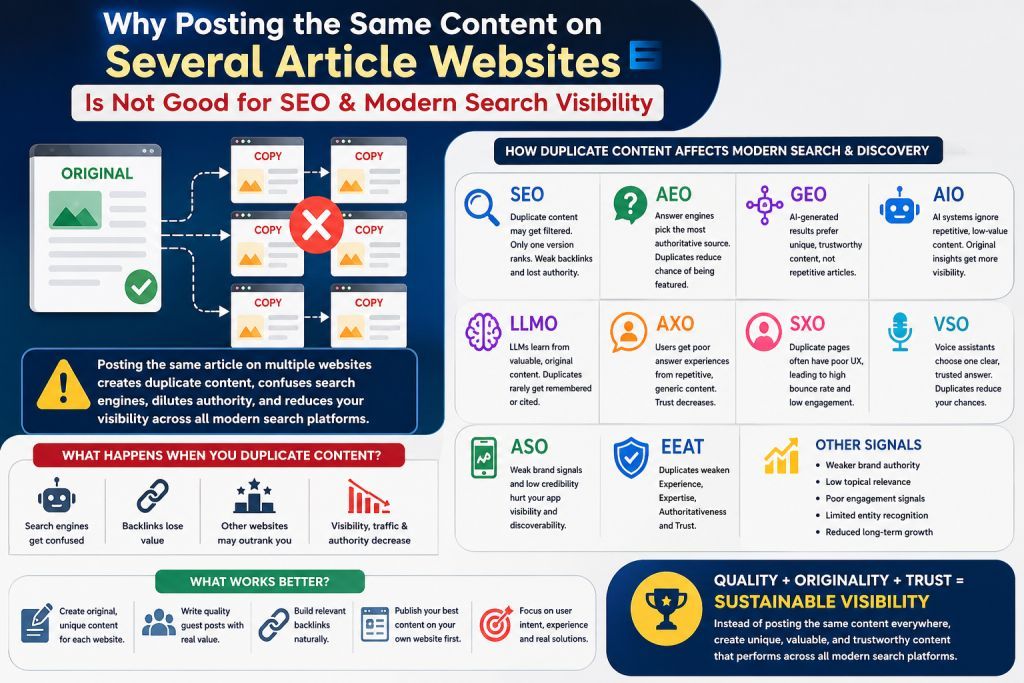
Many website owners still believe that posting the same article on several article submission websites can improve rankings, create backlinks, and increase online visibility. Years ago, this strategy was more common because search engines were less advanced. Today, search engines, AI systems, voice assistants, app discovery engines, and large language models evaluate content very differently.
Modern digital visibility is no longer limited to traditional SEO. Businesses now compete across multiple discovery channels such as AI-generated answers, voice search, app stores, answer engines, user experience signals, and trust-based ranking systems. Because of this shift, posting duplicate content on multiple websites is generally not a smart growth strategy.
Instead of helping, repeated content can weaken authority, confuse search systems, reduce originality signals, and limit visibility across modern platforms.
In this article, we explain how duplicate content across several article websites can negatively affect SEO, AEO, GEO, AIO, LLMO, AXO, SXO, VSO, ASO, EEAT, and other modern search visibility factors.
What Happens When You Post the Same Content Everywhere?
When one article is copied and published across multiple websites, search engines and AI systems must determine:
- Which version is original
- Which version is most trusted
- Which version is most useful
- Which source should be cited
- Which page deserves ranking priority
In many cases, only one version receives visibility while others are ignored.
That means you may spend time publishing on many websites but gain little benefit.
How Duplicate Content Affects SEO (Search Engine Optimization)
Traditional SEO still matters greatly. Search engines like Google reward originality, relevance, backlinks, user engagement, and authority.
Negative SEO Effects:
- Duplicate Content Filtering
Search engines often choose only one version of repeated content to rank.
- Keyword Cannibalization
Several copies of the same topic may compete against each other.
- Weak Link Signals
Low-quality article directory backlinks usually have little value.
- Reduced Crawl Efficiency
Search bots waste resources indexing duplicates instead of your best pages.
- Lower Brand Authority
Your original site may lose rankings to stronger third-party domains.
How Duplicate Content Affects AEO (Answer Engine Optimization)
AEO means optimizing content for direct answers shown in search snippets, AI answers, assistants, and zero-click results.
Answer engines prefer:
- Clear facts
- Original expertise
- Structured content
- Trusted sources
Negative AEO Effects:
- Duplicate articles reduce uniqueness
- AI may choose another website as source
- Your brand may not receive citation credit
- Generic repeated content is less likely to become featured answers
If ten websites have the same answer, systems often select the most authoritative domain—not yours.
How Duplicate Content Affects GEO (Generative Engine Optimization)
GEO focuses on visibility in AI-generated search results and conversational AI systems.
Generative systems prefer:
- Distinctive insights
- Source credibility
- Updated information
- Consensus with authority
Negative GEO Effects:
- Duplicate content looks low-value
- AI models may ignore repetitive sources
- Your content lacks unique perspective
- Another domain may become the cited source
If your article says the same thing as dozens of others, it becomes replaceable.
How Duplicate Content Affects AIO (AI Optimization)
AIO refers to optimizing content for AI discovery, summarization, recommendation, and content understanding.
Negative AIO Effects:
- AI systems struggle to identify original ownership
- Duplicate pages reduce source trust
- Summarizers may exclude repetitive material
- Thin content often loses to expert sources
AI favors useful, distinct, authoritative content.
How Duplicate Content Affects LLMO (Large Language Model Optimization)
LLMO means optimizing content to be referenced or learned from by large language model ecosystems.
Negative LLMO Effects:
- Repetitive content has low training value
- Generic wording lacks memorability
- No expert viewpoint reduces citation potential
- Original source may not be recognized
If your content is unique and insightful, models are more likely to treat it as valuable source material.
How Duplicate Content Affects AXO (Answer Experience Optimization)
AXO focuses on how users receive answers across AI, search, and multi-platform experiences.
Negative AXO Effects:
- Users see repeated low-value content
- Poor trust if same article appears everywhere
- Low satisfaction from recycled information
- Reduced click-through from generic headlines
Modern users expect better experiences than copied article spam.
How Duplicate Content Affects SXO (Search Experience Optimization)
SXO combines SEO with user experience.
Ranking today depends not only on keywords but also experience factors like:
- Readability
- Helpful layout
- Speed
- Intent satisfaction
- Trust signals
Negative SXO Effects:
- Duplicate articles often low quality
- Thin formatting and poor readability common on article sites
- Users bounce quickly
- Low engagement reduces performance signals
How Duplicate Content Affects VSO (Voice Search Optimization)
Voice assistants need one clear, trusted answer.
Examples include assistants on phones, smart speakers, and vehicles.
Negative VSO Effects:
- Duplicate content creates ambiguity
- Assistants choose strongest authority domain
- Your website may not be selected
- Generic writing performs poorly in conversational queries
Voice search rewards concise and authoritative sources.
How Duplicate Content Affects ASO (App Store Optimization)
ASO mainly applies to mobile apps, but brand visibility overlaps with search ecosystems.
If your app brand uses duplicated web content:
Negative ASO Effects:
- Weak brand trust
- Less authority in branded search
- Poor consistency across web and app discovery channels
- Reduced external demand signals
Strong original web presence can support app growth.
How Duplicate Content Affects EEAT
EEAT stands for:
- Experience
- Expertise
- Authoritativeness
- Trustworthiness
This is one of the most important modern quality frameworks.
Duplicate Content Weakens EEAT Because:
Experience
Copied generic articles rarely show real-world experience.
Expertise
Repeated shallow content lacks depth.
Authoritativeness
Publishing everywhere does not equal authority.
Trustworthiness
Users trust original branded sources more than recycled article directories.
Search systems increasingly evaluate trust—not volume.
Other Modern Search Visibility Signals Affected
Brand Signals
Repeated low-quality content can weaken premium brand perception.
Entity Recognition
Search systems identify brands/entities better when original authoritative content exists.
Topical Authority
Duplicate content does not build deep subject coverage.
Engagement Metrics
Copied content often gets low time-on-page and high bounce rates.
Link Quality
Mass article links are weaker than one strong editorial backlink.
What Works Better Instead?
- Publish Original Content on Your Website
Always make your domain the main source.
- Create Unique Guest Posts
Write fresh versions for each external site.
- Add Real Expertise
Use case studies, data, opinions, examples.
- Structure for AI and Answers
Use headings, FAQs, concise definitions.
- Build Topic Clusters
Create multiple related pages around one niche.
- Improve User Experience
Fast loading, mobile-friendly, easy reading.
Example
Instead of posting one article titled:
Best SEO Tips for Businesses
Across 20 websites, do this:
On your website:
- Complete SEO Guide for Local Businesses
On other sites:
- How Restaurants Use SEO to Grow
- SEO Mistakes New Brands Make
- Local SEO for Service Providers
- Why Reviews Matter for Rankings
All unique. All valuable.
This supports SEO, AEO, GEO, and EEAT far better.
Posting the same content on several article websites is generally not good for modern search visibility. It can weaken rankings, reduce originality, confuse AI systems, and damage trust signals across SEO, AEO, GEO, AIO, LLMO, AXO, SXO, VSO, ASO, and EEAT.
Modern search success comes from:
- Original content
- Real expertise
- Better user experience
- Clear structure
- Strong branding
- Quality backlinks
- Consistent authority
One high-quality original article on your own website is usually worth more than many duplicated copies spread across low-value article sites.
In 2026 and beyond, visibility belongs to creators who publish useful, trustworthy, unique content—not repeated content everywhere.