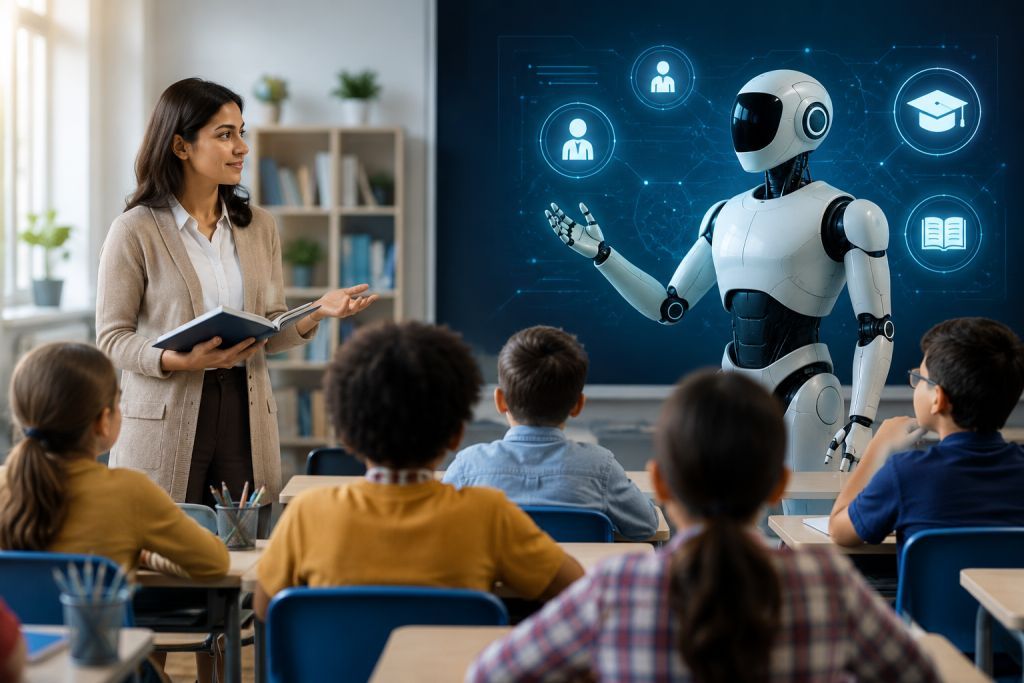
Artificial Intelligence is rapidly changing education by making learning more personalized, accessible, and efficient. AI-powered tutors, adaptive learning platforms, automated grading systems, and intelligent educational assistants are becoming common in schools, universities, and online learning platforms around the world. As these technologies continue to improve, an important question arises: Can AI replace teachers in the future?
The short answer is that AI will almost certainly transform teaching, but it is unlikely to completely replace teachers. Education involves much more than delivering information. Great teachers inspire curiosity, build confidence, encourage critical thinking, understand emotions, mentor students, and create positive classroom environments. These uniquely human qualities remain difficult for AI to replicate.
Artificial Intelligence excels at analyzing large amounts of data, adapting lessons to individual learning speeds, providing instant feedback, and automating repetitive administrative work. These capabilities allow teachers to spend less time on paperwork and more time supporting students. Rather than replacing educators, AI is increasingly becoming a powerful teaching assistant that enhances classroom learning.
The future classroom will likely combine the strengths of both AI and human teachers. Technology will handle routine tasks and personalized content delivery, while teachers focus on communication, creativity, emotional development, leadership, and meaningful human interaction.
This guide explores what AI can and cannot do in education, why teachers remain essential, and how AI and educators are expected to work together in the coming years.
Quick Answer: Can AI Replace Teachers in the Future?
No, AI is unlikely to completely replace teachers. While Artificial Intelligence can personalize learning, automate grading, provide intelligent tutoring, and analyze student progress, it cannot fully replicate human empathy, mentorship, creativity, classroom leadership, emotional intelligence, ethical judgment, and personal relationships. The future of education will most likely combine AI technology with human teachers to create more effective learning experiences.
What Is AI in Education?
AI in education refers to the use of Artificial Intelligence technologies to improve teaching, learning, assessment, and educational administration. AI systems can understand questions, analyze learning patterns, generate educational content, recommend study materials, and support both teachers and students throughout the learning process.
Common examples include:
- AI tutors.
- Virtual learning assistants.
- Adaptive learning platforms.
- Automatic grading systems.
- Language translation tools.
- Learning analytics dashboards.
- Content generation assistants.
These technologies help personalize education while improving efficiency across many educational settings.
Can AI Replace Teachers?
Although AI continues to become more capable, teaching involves complex human interactions that extend beyond presenting information. Successful education depends on trust, encouragement, empathy, communication, creativity, and personal guidance.
AI performs exceptionally well when tasks involve:
- Processing information.
- Recognizing learning patterns.
- Generating educational content.
- Providing instant feedback.
- Answering routine questions.
- Automating repetitive work.
However, education also requires understanding emotions, motivating students, resolving conflicts, adapting to unexpected classroom situations, and building meaningful relationships—areas where human teachers continue to play the central role.
Why Teachers Remain Essential
Teachers do much more than explain academic subjects. They guide students through personal growth while helping them develop confidence, resilience, curiosity, collaboration, and ethical decision-making.
Teachers help students:
- Develop critical thinking.
- Build confidence.
- Improve communication skills.
- Learn teamwork.
- Handle emotional challenges.
- Develop creativity.
- Become responsible citizens.
These responsibilities require emotional understanding, flexibility, and interpersonal skills that extend beyond today's AI capabilities.
Tasks AI Can Perform Well
Artificial Intelligence is highly effective at supporting education through automation and personalized learning experiences.
AI can efficiently:
- Grade quizzes.
- Create personalized learning plans.
- Answer frequently asked questions.
- Recommend learning resources.
- Generate practice exercises.
- Track student progress.
- Identify learning gaps.
By handling these routine activities, AI allows educators to devote more attention to teaching and mentoring.
Personalized Learning
One of AI's greatest strengths is adapting educational content to each student's needs. Instead of delivering identical lessons to every learner, AI systems can adjust difficulty levels, recommend additional practice, and provide customized learning paths.
Personalized learning includes:
- Adaptive quizzes.
- Individual study recommendations.
- Customized revision plans.
- Learning pace adjustments.
- Progress tracking.
- Targeted skill development.
This flexibility helps students learn more efficiently while supporting diverse learning styles.
AI Tutoring and Instant Feedback
AI-powered tutors can answer questions, explain concepts, provide examples, and generate practice exercises at any time of day.
Students benefit from:
- Immediate explanations.
- Homework assistance.
- Practice quizzes.
- Writing feedback.
- Coding guidance.
- Language practice.
Although AI tutors provide valuable assistance, they work best as learning companions rather than replacements for classroom instruction.
Classroom Automation
Many administrative responsibilities consume significant amounts of teacher time. AI can automate routine processes that allow educators to focus more on student learning.
Examples include:
- Grading objective assessments.
- Attendance management.
- Lesson organization.
- Performance reporting.
- Scheduling.
- Learning analytics.
Automation improves efficiency while reducing repetitive administrative workloads.
Human Skills AI Cannot Replace
Despite impressive technological progress, several essential teaching abilities remain uniquely human.
These include:
- Empathy.
- Emotional support.
- Ethical decision-making.
- Mentorship.
- Leadership.
- Conflict resolution.
- Creative inspiration.
- Building trust.
- Understanding social dynamics.
These qualities shape students' personal development as much as their academic success.
Emotional Intelligence in Teaching
Teachers recognize when students feel anxious, discouraged, confused, or unmotivated. They adjust their teaching style, offer encouragement, celebrate achievements, and create supportive classroom environments.
Emotional intelligence helps teachers:
- Build positive relationships.
- Recognize learning barriers.
- Support mental well-being.
- Encourage collaboration.
- Inspire confidence.
- Promote resilience.
While AI can recognize certain behavioral patterns, it cannot genuinely understand or experience human emotions in the same way educators do.
Responsible Integration of AI in Education
The greatest educational benefits come from combining AI technology with experienced teachers rather than choosing one over the other.
Best practices include:
- Using AI to support personalized learning.
- Allowing teachers to focus on mentoring and classroom interaction.
- Verifying AI-generated information.
- Teaching responsible AI literacy.
- Protecting student privacy.
- Encouraging critical thinking alongside AI assistance.
As education continues to evolve, AI will become an increasingly valuable classroom partner. However, the human qualities that define excellent teaching—compassion, inspiration, ethical guidance, creativity, and meaningful relationships—ensure that teachers will remain at the center of education for the foreseeable future.
AI vs Human Teachers: A Comparison
| Area | Artificial Intelligence | Human Teachers |
|---|---|---|
| Personalized Learning | Adapts lessons automatically | Adapts using experience and observation |
| Availability | 24/7 assistance | Limited to school and office hours |
| Feedback Speed | Instant | Usually delayed depending on workload |
| Emotional Support | Very Limited | Excellent |
| Creativity | Generates ideas from data | Original teaching approaches and inspiration |
| Classroom Management | Cannot manage physical classrooms | Highly effective |
| Mentorship | Limited | Strong personal guidance |
| Ethical Judgment | Rule-based responses | Human judgment and values |
Tasks AI Can and Cannot Perform
| Task | AI Capability | Teacher Role |
|---|---|---|
| Automatic Grading | Excellent | Reviews complex assignments |
| Homework Assistance | Excellent | Explains concepts deeply |
| Lesson Planning | Assists with content generation | Designs meaningful learning experiences |
| Student Motivation | Limited | Provides encouragement and inspiration |
| Conflict Resolution | Very Limited | Handles classroom situations effectively |
| Critical Thinking Development | Supports practice | Guides discussion and reasoning |
| Parent Communication | Can draft messages | Builds trusted relationships |
| Emotional Guidance | Cannot genuinely empathize | Provides human understanding and support |
Benefits of AI-Assisted Teaching
| Benefit | Impact |
|---|---|
| Personalized Learning | Students learn at their own pace. |
| Reduced Administrative Work | Teachers spend more time teaching. |
| Instant Feedback | Students correct mistakes more quickly. |
| 24/7 Learning Support | Students receive assistance anytime. |
| Learning Analytics | Identifies strengths and learning gaps. |
| Greater Accessibility | Supports learners with diverse needs. |
Human Strengths vs AI Strengths
| Human Teacher Strengths | AI Strengths |
|---|---|
| Empathy | Fast information processing |
| Leadership | Personalized recommendations |
| Mentorship | 24/7 availability |
| Ethical judgment | Instant feedback |
| Creativity | Automated grading |
| Classroom management | Learning analytics |
| Relationship building | Content generation |
Advantages and Challenges
| Advantages | Challenges |
|---|---|
| More personalized education | AI cannot replace human relationships |
| Reduced teacher workload | Requires responsible AI use |
| Improved accessibility | Privacy and data security concerns |
| Instant learning support | Students may become overdependent |
| Better learning insights | Information must sometimes be verified |
| Greater learning flexibility | Technology access varies across schools |
Common Misconceptions About AI Replacing Teachers
| Misconception | Reality |
|---|---|
| AI will replace all teachers. | AI is more likely to assist teachers than replace them. |
| AI understands emotions. | AI can recognize patterns but does not experience emotions. |
| AI always provides correct answers. | AI responses should be verified when accuracy is important. |
| Students won't need classrooms. | Schools remain important for collaboration, mentoring, and social development. |
| AI teaches creativity. | Teachers continue to inspire creativity through human interaction. |
| AI can motivate every student equally. | Human encouragement remains a critical part of learning. |
Tips for Teachers Using AI Effectively
Use AI to Save Time
Automate repetitive tasks such as quiz generation, grading objective assessments, lesson summaries, and administrative reporting so more time can be spent interacting with students.
Focus on Human-Centered Teaching
Use classroom time for discussion, collaboration, mentoring, creativity, and problem-solving while allowing AI to support routine instructional tasks.
Teach AI Literacy
Help students understand how AI works, its limitations, responsible usage, and the importance of verifying AI-generated information.
Protect Student Privacy
Use educational AI platforms responsibly and avoid sharing confidential student information with AI systems.
Encourage Independent Thinking
Ask students to explain their reasoning, evaluate AI responses critically, and develop original ideas rather than relying entirely on AI assistance.
The Future of AI and Education
AI as a Classroom Assistant
Future classrooms are expected to use AI as a teaching assistant that supports personalized instruction, assessment, and student engagement while teachers remain responsible for guiding learning.
More Adaptive Learning
AI systems will likely become even better at identifying learning gaps and recommending individualized study plans based on each student's progress.
Smarter Educational Tools
Virtual tutors, intelligent simulations, automatic translations, and accessibility technologies will continue improving educational opportunities for diverse learners.
Greater Teacher Empowerment
Rather than replacing educators, AI is expected to reduce administrative burdens and provide valuable insights that improve teaching effectiveness.
Human Skills Become More Valuable
As AI handles repetitive tasks, skills such as empathy, communication, creativity, ethical leadership, and emotional intelligence will become even more important in education.
Featured Snippet: Can AI Replace Teachers in the Future?
No. Artificial Intelligence is unlikely to completely replace teachers because education involves far more than delivering information. AI can personalize learning, automate grading, provide tutoring, and analyze student progress, but it cannot fully replace empathy, mentorship, creativity, classroom leadership, ethical judgment, and meaningful human relationships. The future of education will most likely combine AI technology with experienced teachers to create more effective and personalized learning experiences.
Frequently Asked Questions
1. Can AI completely replace teachers?
No. AI can support teaching but cannot fully replace the human qualities that educators bring to the classroom.
2. What can AI do better than teachers?
AI can automate grading, personalize learning paths, analyze data, answer routine questions, and provide learning support around the clock.
3. Why are teachers still necessary?
Teachers provide emotional support, mentorship, classroom leadership, ethical guidance, creativity, and social interaction.
4. Will AI improve education?
Yes. AI can make education more personalized, accessible, efficient, and data-driven when used responsibly.
5. Can AI understand students' emotions?
AI can recognize certain patterns, but it does not genuinely experience empathy or human emotions.
6. Will AI reduce teacher workloads?
Yes. AI can automate many repetitive administrative tasks, allowing teachers to spend more time teaching.
7. Can AI create lesson plans?
Yes. AI can assist in generating lesson ideas and educational materials, but teachers adapt them for their students.
8. Is AI available outside school hours?
Yes. AI learning assistants can provide educational support at any time.
9. Can AI motivate students?
AI can encourage learning through personalization and feedback, but genuine inspiration and mentorship come from teachers.
10. Will classrooms disappear?
No. Schools remain essential for collaboration, social development, communication, and real-world learning experiences.
11. Can AI assess student progress?
Yes. AI can analyze performance data and identify strengths and learning gaps.
12. Should students trust every AI response?
No. Important academic information should always be verified using reliable educational resources.
13. What skills will teachers need in the AI era?
Teachers will increasingly focus on mentoring, creativity, emotional intelligence, leadership, AI literacy, and critical thinking instruction.
14. Can AI improve personalized learning?
Yes. AI can adjust lesson difficulty, recommend resources, and create individualized learning paths.
15. Will AI replace schools?
No. Educational institutions provide community, collaboration, supervision, and experiences that technology alone cannot replace.
16. What is the biggest limitation of AI in education?
Its inability to genuinely understand emotions, build human relationships, and exercise human judgment in complex situations.
17. What is the future relationship between AI and teachers?
The future is expected to involve collaboration, where AI handles repetitive tasks while teachers focus on inspiring, mentoring, and developing students' academic and personal growth.
Summary
Artificial Intelligence is reshaping education by providing personalized learning, intelligent tutoring, automated grading, and data-driven insights that improve teaching efficiency and student outcomes. These technologies help reduce repetitive administrative work while making learning more flexible and accessible. However, education is fundamentally a human-centered process that involves communication, trust, emotional support, creativity, leadership, and ethical guidance—qualities that AI cannot fully replicate.
Rather than replacing teachers, AI is expected to become an increasingly valuable educational partner. The most successful classrooms of the future will combine AI's speed, personalization, and analytical capabilities with the empathy, experience, and inspiration of skilled educators. By integrating AI responsibly and emphasizing critical thinking, collaboration, and lifelong learning, schools can prepare students for a future where both human expertise and intelligent technologies work together to create richer educational experiences.
Sources
- UNESCO – Artificial Intelligence and Education
- OECD – Education and Skills
- OpenAI – Research
- Microsoft Learn – AI and Education
- Edutopia – Teaching and Learning Strategies
- American Psychological Association – Learning Resources
- The Learning Scientists – Evidence-Based Learning Strategies
- European Commission – Digital Education Action Plan
- Grow with Google – Education and Digital Skills
- Coursera – AI in Education