Hair loss affects millions of people worldwide and can be caused by genetics, hormonal changes, medical conditions, nutritional deficiencies, stress, medications, and lifestyle factors. As artificial intelligence continues to transform healthcare, many people are asking: Can AI help identify hair loss causes?
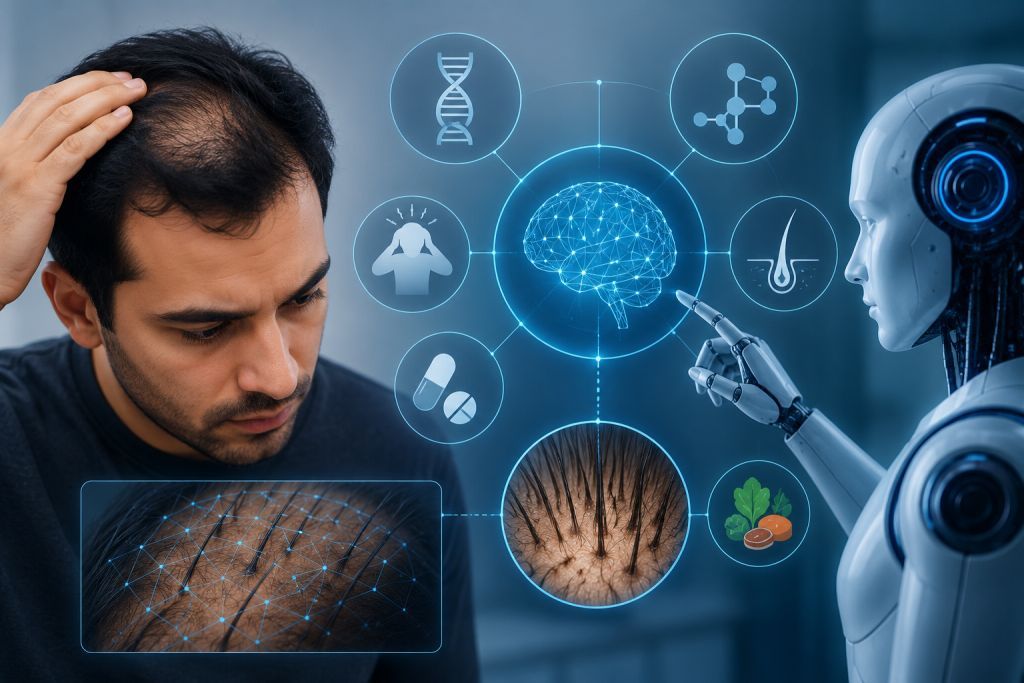
The short answer is yes—AI can assist in identifying possible hair loss patterns and potential causes. Modern AI systems can analyze photographs, scalp images, medical histories, and symptom data to detect patterns that may be associated with certain forms of hair loss.
However, AI should be viewed as a support tool rather than a replacement for medical professionals. While AI can help screen for possible conditions and provide useful insights, a complete diagnosis often requires clinical examination, laboratory testing, and evaluation by a dermatologist or healthcare provider.
This guide explains how AI hair analysis works, what causes of hair loss AI can help identify, its benefits and limitations, and what users should realistically expect from AI-powered hair assessment tools.
Quick Answer
Yes, AI can help identify potential causes of hair loss by analyzing hair density, scalp images, hairline patterns, symptom information, and medical data.
AI may help detect signs associated with:
- Male pattern baldness
- Female pattern hair loss
- Alopecia areata
- Hair thinning
- Stress-related shedding
- Scalp conditions
- Early-stage hair loss patterns
However, AI cannot replace professional medical diagnosis and should be used as a screening or decision-support tool.
Key Facts
- AI can analyze scalp photographs and hair patterns.
- Machine learning models can identify visual indicators of certain hair loss conditions.
- AI is increasingly used in dermatology and telemedicine.
- Image quality greatly affects AI accuracy.
- Laboratory testing is often required to identify underlying medical causes.
- Dermatologist evaluation remains the gold standard for diagnosis.
What Is Hair Loss?
Hair loss, also known as alopecia, refers to partial or complete loss of hair from the scalp or other areas of the body.
Hair loss may occur gradually or suddenly and can affect people of all ages.
Common symptoms include:
- Thinning hair
- Receding hairline
- Bald patches
- Excessive shedding
- Reduced hair density
- Widening part line
The underlying cause often determines the pattern and severity of hair loss.
Common Causes of Hair Loss
Understanding the cause of hair loss is essential for choosing the most effective treatment.
Common causes include:
- Genetics
- Hormonal changes
- Aging
- Stress
- Nutritional deficiencies
- Autoimmune disorders
- Scalp infections
- Certain medications
- Medical conditions
- Hair styling damage
Some causes are easier for AI systems to identify than others.
What Is AI Hair Analysis?
AI hair analysis refers to the use of artificial intelligence and machine learning algorithms to evaluate hair and scalp characteristics.
The technology often uses:
- Photographs
- Scalp images
- Patient questionnaires
- Medical history information
- Pattern recognition models
The goal is to identify visual signs associated with various forms of hair loss and provide possible explanations.
How AI Helps Analyze Hair Loss
AI systems are trained using large datasets containing thousands or even millions of images and clinical examples.
When a new image is uploaded, the system compares the image against learned patterns.
The AI may evaluate:
- Hair density
- Hairline position
- Follicle visibility
- Scalp exposure
- Hair thickness
- Pattern distribution
The analysis can then generate insights regarding possible causes of hair loss.
Can AI Identify Male Pattern Baldness?
Yes. Male pattern baldness is one of the conditions AI systems are often most capable of recognizing.
Characteristic features include:
- Receding hairline
- Thinning at the crown
- Predictable progression patterns
Because these patterns are visually distinctive, machine learning models can often identify them effectively.
Can AI Identify Female Pattern Hair Loss?
In many cases, yes.
Female pattern hair loss often presents as:
- Diffuse thinning
- Widening of the hair part
- Reduced hair density
AI tools may help detect these changes and identify trends over time.
Can AI Detect Alopecia Areata?
Alopecia areata is an autoimmune condition that often causes round or patchy areas of hair loss.
Because the condition frequently produces distinct visual patterns, AI systems may be able to identify features associated with alopecia areata.
However, confirmation by a healthcare professional remains important.
Can AI Identify Stress-Related Hair Loss?
Stress-related hair loss, often referred to as telogen effluvium, can be more difficult for AI systems to identify.
This is because diagnosis often depends on:
- Medical history
- Recent life events
- Health changes
- Laboratory testing
AI may recognize generalized thinning but cannot always determine whether stress is the underlying cause.
Can AI Detect Nutritional Deficiency Hair Loss?
Nutritional deficiencies may contribute to hair thinning and shedding.
Common deficiencies associated with hair loss include:
- Iron deficiency
- Vitamin D deficiency
- Protein deficiency
- Zinc deficiency
Because these conditions often require blood testing for confirmation, AI can only provide limited assistance in identifying them.
Can AI Analyze Scalp Health?
Some advanced AI systems can evaluate scalp characteristics in addition to hair density.
Potential indicators include:
- Scalp redness
- Inflammation
- Scaling
- Dandruff-related changes
- Follicle visibility
This information may help support preliminary assessments.
Key Statistics About Hair Loss and AI in Healthcare
Hair loss is one of the most common concerns addressed by dermatologists worldwide, and AI adoption in healthcare continues to grow rapidly.
- Millions of men and women experience some form of hair loss during their lifetime.
- Androgenetic alopecia (pattern baldness) is the most common cause of hair loss worldwide.
- Telemedicine and AI-assisted dermatology tools are increasingly being used for preliminary skin and hair assessments.
- Machine learning models can analyze thousands of images within seconds, helping identify patterns that may be difficult to detect manually.
- AI-assisted healthcare tools continue to improve as training datasets become larger and more diverse.
While these technologies are advancing quickly, experts generally recommend combining AI insights with professional medical evaluation.
Benefits of Using AI to Identify Hair Loss Causes
Artificial intelligence offers several advantages when used appropriately.
1. Faster Initial Assessment
AI systems can analyze images and symptom information within seconds, providing immediate feedback.
2. Pattern Recognition
Machine learning algorithms excel at recognizing visual patterns associated with common hair loss conditions.
3. Accessibility
People who do not have immediate access to dermatologists may benefit from preliminary AI-based assessments.
4. Monitoring Progress Over Time
AI tools can compare images over weeks or months to track hair growth, hair density, and treatment effectiveness.
5. Support for Telemedicine
Many telehealth platforms integrate AI tools to assist healthcare professionals in evaluating patient-submitted images.
Challenges and Limitations of AI Hair Analysis
Despite its potential, AI has important limitations.
1. Image Quality Issues
Blurry, poorly lit, or low-resolution images can significantly reduce analysis accuracy.
2. Lack of Laboratory Data
Many causes of hair loss require blood tests and medical evaluations that AI cannot perform independently.
3. Similar Appearance of Different Conditions
Multiple hair loss disorders can appear visually similar, making accurate diagnosis challenging.
4. Limited Medical History Context
Factors such as medications, recent illnesses, hormonal changes, and family history often influence diagnosis.
5. Risk of Misinterpretation
Users may incorrectly assume that AI results represent a confirmed medical diagnosis.
AI should be viewed as a supportive screening tool rather than a definitive diagnostic system.
AI vs Dermatologist: Which Is Better for Diagnosing Hair Loss?
| Feature | AI Analysis | Dermatologist |
|---|---|---|
| Image Analysis | Excellent | Excellent |
| Medical History Review | Limited | Comprehensive |
| Physical Examination | No | Yes |
| Blood Test Evaluation | No | Yes |
| Diagnosis Confirmation | Limited | Yes |
| Treatment Planning | Basic Guidance | Comprehensive |
| Accessibility | Very High | Depends on Location |
| Speed | Immediate | Appointment Required |
For best results, AI and dermatologists should be viewed as complementary rather than competing resources.
How Accurate Is AI for Hair Loss Detection?
The accuracy of AI depends on several factors.
- Quality of training data
- Diversity of patient images
- Image resolution
- Condition being evaluated
- Algorithm sophistication
AI tends to perform better when identifying common conditions with distinctive visual patterns, such as male pattern baldness.
Accuracy may be lower when evaluating conditions that require laboratory testing or detailed clinical history.
Can AI Recommend Hair Loss Treatments?
Some AI-powered platforms provide educational recommendations based on user inputs.
Potential suggestions may include:
- Lifestyle modifications
- Scalp care recommendations
- General hair health guidance
- Medical consultation recommendations
However, treatment decisions should be reviewed by qualified healthcare professionals.
Can AI Predict Future Hair Loss?
Some advanced systems attempt to estimate future hair loss progression by analyzing current patterns and historical data.
Potential predictive factors include:
- Hairline recession
- Crown thinning
- Family history
- Hair density changes
While predictions may be useful, they are not guarantees and should be interpreted cautiously.
How AI Is Used in Dermatology Clinics
AI is increasingly being integrated into dermatology practices.
Healthcare providers may use AI to:
- Assist image analysis
- Track treatment progress
- Identify visual abnormalities
- Improve workflow efficiency
- Support teledermatology services
Most clinics use AI as a decision-support tool rather than an independent diagnostic system.
The Future of AI in Hair Loss Diagnosis
The future of AI in hair care and dermatology appears promising.
Expected advancements include:
- More accurate image recognition
- Integration with laboratory data
- Personalized treatment recommendations
- Improved telehealth capabilities
- Earlier detection of hair loss conditions
As technology evolves, AI may become an increasingly valuable tool in hair health management.
Pros and Cons of AI Hair Loss Analysis
| Pros | Cons |
|---|---|
| Fast assessments | Cannot replace medical diagnosis |
| Convenient access | Dependent on image quality |
| Pattern recognition capabilities | Limited medical context |
| Progress tracking | Cannot perform laboratory testing |
| Supports telemedicine | Potential for false results |
When Should You See a Dermatologist?
You should consider professional medical evaluation if you experience:
- Sudden hair loss
- Patchy bald spots
- Scalp inflammation
- Persistent shedding
- Rapid thinning
- Hair loss associated with illness
- Unexplained changes in hair growth
Early evaluation can help identify underlying causes and improve treatment outcomes.
Frequently Asked Questions
Can AI help identify hair loss causes?
Yes. AI can analyze hair and scalp images, recognize patterns, and suggest possible causes of hair loss.
Can AI diagnose hair loss?
AI can assist with screening and assessment, but a qualified healthcare professional should confirm diagnoses.
Is AI hair analysis accurate?
AI can be accurate for identifying certain visual patterns, but accuracy varies depending on the condition and data quality.
Can AI detect male pattern baldness?
Yes. Male pattern baldness is one of the conditions AI systems commonly recognize.
Can AI identify nutritional deficiencies causing hair loss?
Not reliably. Nutritional deficiencies often require laboratory testing for confirmation.
Can AI replace a dermatologist?
No. AI is best used as a support tool and cannot fully replace professional medical evaluation.
Should I trust AI hair loss assessments?
AI assessments can provide useful insights, but results should be verified through professional medical consultation when necessary.
Summary
AI can help identify potential causes of hair loss by analyzing scalp images, hair density, hairline patterns, and symptom information. It is particularly effective at recognizing common forms of hair loss such as male pattern baldness, female pattern hair loss, and certain visible scalp conditions. However, many causes of hair loss require medical history review, physical examinations, and laboratory testing that AI cannot perform independently. As a result, AI should be viewed as a valuable screening and monitoring tool rather than a replacement for dermatologists.
Conclusion
Artificial intelligence is becoming an increasingly useful tool for identifying possible hair loss causes and supporting dermatology assessments. By leveraging advanced image recognition and machine learning technologies, AI can help detect patterns, monitor progression, and provide preliminary insights into common hair loss conditions.
While these technologies offer speed, convenience, and accessibility, they cannot fully replace professional medical expertise. The most effective approach combines AI-powered analysis with evaluation by qualified healthcare professionals who can perform comprehensive assessments and develop personalized treatment plans.