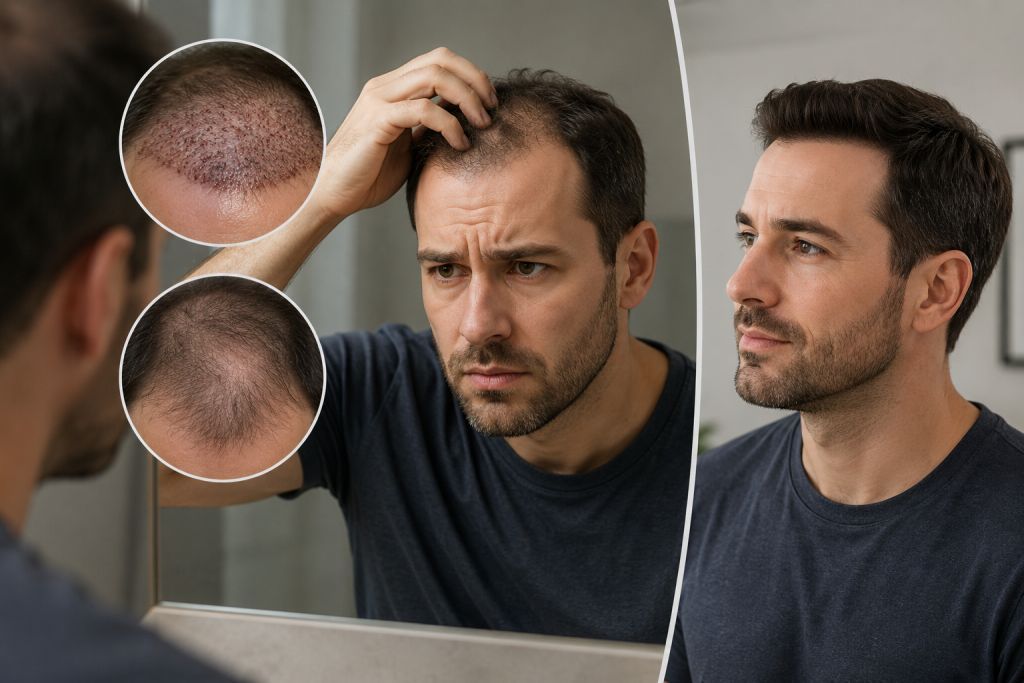
Hair transplantation is considered one of the most effective long-term solutions for restoring hair lost due to pattern baldness and certain other forms of hair loss. Most patients expect to see significant improvements within the first year after surgery, and many enjoy permanent results for decades.
However, some patients become concerned when they notice thinning, reduced density, uneven growth, or changes in their appearance after reaching the one-year mark. This often leads to an important question: Can a hair transplant fail after one year?
The answer is more nuanced than a simple yes or no. In many cases, transplanted hair follicles remain healthy and permanent. However, factors such as continued natural hair loss, poor graft survival, underlying medical conditions, unrealistic expectations, or surgical complications may affect the overall appearance of results.
This guide explains what constitutes a true hair transplant failure, what can happen after one year, and how patients can maximize long-term success.
Quick Answer
A true hair transplant failure after one year is relatively uncommon. By the one-year mark, most successful transplants have already produced substantial growth.
However, patients may perceive failure due to:
- Continued loss of native hair
- Poor graft survival
- Low density
- Unnatural hairline design
- Underlying medical conditions
- Progressive pattern baldness
In many cases, the transplanted follicles themselves remain permanent, while other factors affect the overall cosmetic outcome.
Key Facts
- Most transplanted follicles are designed to be permanent.
- One year is often considered a major milestone for evaluating results.
- Some patients continue seeing improvements up to 18 months.
- Native hair may continue thinning after surgery.
- Hair transplant success depends on both surgical and biological factors.
- Long-term planning is important for progressive hair loss.
What Is Considered a Hair Transplant Failure?
Not every disappointing result qualifies as a true transplant failure.
Hair transplant failure generally refers to situations where:
- Grafts fail to survive.
- Little or no growth occurs.
- Significant scarring develops.
- Results appear severely unnatural.
- Complications affect long-term outcomes.
In contrast, some patients simply experience lower-than-expected density or ongoing native hair loss rather than actual graft failure.
What Should Hair Look Like After One Year?
By 12 months after surgery, many patients have achieved the majority of their visible results.
Common expectations include:
- Significant new growth
- Improved hairline definition
- Increased density
- Natural hair direction
- Matured appearance of transplanted hair
Some patients continue seeing subtle improvements between months 12 and 18.
Can Transplanted Hair Fall Out After One Year?
Generally, transplanted follicles harvested from stable donor areas are genetically resistant to pattern baldness.
Because of this, permanently transplanted follicles usually continue growing for many years.
However, there are exceptions.
Hair loss occurring after one year may involve:
- Native non-transplanted hair
- Medical conditions
- Inflammatory scalp disorders
- Rare graft survival issues
The exact cause requires professional evaluation.
Hair Transplant Timeline Beyond One Year
| Time After Surgery | Typical Expectations |
|---|---|
| 0–3 Months | Shock loss and healing |
| 3–6 Months | Early regrowth begins |
| 6–9 Months | Increasing density |
| 9–12 Months | Major cosmetic improvements |
| 12–18 Months | Final maturation for many patients |
| 2–10 Years | Long-term maintenance phase |
Cause #1: Ongoing Native Hair Loss
The most common reason patients believe their transplant failed is ongoing loss of non-transplanted hair.
Hair transplant surgery does not stop genetic pattern baldness.
As native hair continues thinning, the contrast between transplanted and non-transplanted areas may become more noticeable.
This may create the appearance of worsening results despite healthy transplanted follicles.
Cause #2: Poor Graft Survival
In some cases, transplanted follicles may not survive at expected rates.
Potential factors include:
- Improper graft handling
- Technical surgical issues
- Poor blood supply
- Infection
- Scalp trauma
Reduced graft survival may contribute to lower density than anticipated.
Cause #3: Unrealistic Expectations
Hair transplantation improves hair density but rarely restores childhood-level hair volume.
Some patients expect:
- Extremely dense coverage
- Perfect symmetry
- Complete restoration of youthful hairlines
When expectations exceed realistic outcomes, patients may perceive results as unsuccessful even when the procedure technically succeeded.
Cause #4: Poor Hairline Design
Hairline design plays a critical role in patient satisfaction.
Potential issues include:
- Hairline placed too low
- Unnatural shape
- Improper graft distribution
- Artificial appearance
Even healthy graft growth may not compensate for poor design choices.
Cause #5: Underlying Medical Conditions
Certain medical conditions may affect hair growth after transplantation.
Examples include:
- Thyroid disorders
- Autoimmune diseases
- Nutritional deficiencies
- Chronic illness
- Inflammatory scalp conditions
These conditions may influence overall hair health and appearance.
Signs of a Successful vs Failed Hair Transplant
| Successful Outcome | Potential Failure Indicators |
|---|---|
| Consistent growth | Minimal growth |
| Natural appearance | Unnatural appearance |
| Improved density | Persistent sparse coverage |
| Stable graft survival | Poor graft survival |
| High patient satisfaction | Significant dissatisfaction |
Can Hair Loss Continue After a Hair Transplant?
Yes.
This is one of the most misunderstood aspects of hair restoration.
A transplant addresses existing hair loss but does not stop future progression of genetic baldness.
Many patients continue experiencing gradual thinning of untreated hair over time.
This is why long-term treatment planning is often recommended.
Hair Transplant Statistics and Long-Term Success Rates
Modern hair transplantation techniques have significantly improved over the past two decades. When performed by experienced surgeons using proper techniques, hair transplants generally achieve high graft survival rates and long-lasting results.
- Most successful hair transplants show substantial growth by 12 months.
- Many patients continue seeing improvements between months 12 and 18.
- FUE and FUT procedures can provide permanent hair restoration when donor follicles remain healthy.
- Long-term satisfaction often depends on realistic expectations and ongoing hair loss management.
- Future hair loss progression remains one of the biggest factors affecting long-term appearance.
While true transplant failure after one year is uncommon, cosmetic changes may still occur due to other factors.
Cause #6: Progressive Pattern Baldness
Male and female pattern hair loss often continue progressing after surgery.
This means:
- Native hair may continue thinning.
- Previously healthy hair may become weaker.
- New bald areas may develop.
- The contrast between transplanted and native hair may become more noticeable.
This progression can sometimes create the impression that the transplant has failed when the transplanted follicles remain healthy.
Cause #7: Inadequate Graft Numbers
Some patients simply do not receive enough grafts to achieve their desired density.
Possible reasons include:
- Limited donor hair supply
- Conservative surgical planning
- Large treatment areas
- Budget limitations
In such cases, the transplant may technically succeed while still leaving areas that appear thinner than expected.
Cause #8: Scalp Conditions
Certain scalp disorders may affect long-term hair health.
Examples include:
- Scalp psoriasis
- Seborrheic dermatitis
- Folliculitis
- Scarring alopecia conditions
Proper diagnosis and treatment are important to protect both transplanted and native hair.
Cause #9: Lifestyle Factors
Although transplanted follicles are generally permanent, overall hair health can still be influenced by lifestyle habits.
Potential contributing factors include:
- Smoking
- Poor nutrition
- Chronic stress
- Inadequate sleep
- Poor scalp care
Healthy habits support both recovery and long-term hair quality.
Factors That Affect Long-Term Hair Transplant Results
| Factor | Potential Impact |
|---|---|
| Surgeon experience | Influences graft survival and natural appearance |
| Donor hair quality | Affects long-term coverage |
| Age | May influence future hair loss progression |
| Genetics | Determines ongoing baldness risk |
| Medical conditions | May affect hair health |
| Post-operative care | Supports graft survival |
| Lifestyle habits | Influence overall hair quality |
How to Protect Your Hair Transplant Results
Patients can take several steps to support long-term success.
- Follow your surgeon's recommendations.
- Attend follow-up appointments.
- Monitor ongoing hair loss.
- Maintain good scalp health.
- Eat a balanced diet.
- Manage stress effectively.
- Avoid smoking when possible.
- Seek prompt treatment for scalp disorders.
Long-term maintenance often plays an important role in preserving cosmetic results.
Can a Second Hair Transplant Be Needed?
Yes.
Some patients choose additional procedures because:
- Hair loss continues progressing.
- They desire greater density.
- New thinning areas develop.
- The original procedure was conservative.
A second procedure does not necessarily mean the first transplant failed.
When Should You Contact Your Surgeon?
Consider consulting your surgeon if you notice:
- Very limited growth after one year
- Persistent scalp inflammation
- Unusual scarring
- Sudden hair loss in transplanted areas
- Significant cosmetic concerns
- Questions about future hair loss
Your surgeon can help determine whether the issue involves graft survival, ongoing baldness, or another factor.
Common Myths About Hair Transplant Failure
Myth #1: Every Hair Loss After Surgery Means Failure
Not necessarily. Native hair may continue thinning even when transplanted follicles remain healthy.
Myth #2: Hair Transplants Stop Baldness Forever
Transplanted hair is generally permanent, but future hair loss can still occur in untreated areas.
Myth #3: One Year Guarantees Final Results for Everyone
Some patients continue experiencing improvements up to 18 months after surgery.
Myth #4: A Second Procedure Means the First One Failed
Additional procedures are often performed to address ongoing hair loss or improve density.
Pros and Cons of Hair Transplant Surgery
| Pros | Cons |
|---|---|
| Long-lasting results | Requires surgery |
| Natural-looking appearance | Can be costly |
| Permanent donor follicles | Recovery period required |
| Improved confidence for many patients | Future hair loss may continue |
| Customizable treatment plans | Additional procedures may be needed |
Frequently Asked Questions
Can a hair transplant fail after one year?
True failure after one year is uncommon, but issues such as ongoing native hair loss, poor density, or unrealistic expectations may affect satisfaction.
Can transplanted hair fall out years later?
Healthy transplanted follicles are generally permanent, although other hair may continue thinning.
How do I know if my transplant failed?
Minimal growth, poor density, unnatural appearance, or significant cosmetic concerns should be evaluated by a qualified surgeon.
Can stress affect my hair transplant results?
Stress may influence overall hair health, although transplanted follicles are usually resistant to genetic hair loss.
Is it normal to lose native hair after a transplant?
Yes. Pattern baldness can continue affecting non-transplanted hair after surgery.
Can I need another transplant in the future?
Yes. Some patients choose additional procedures to address future hair loss or increase density.
What is the biggest cause of dissatisfaction after one year?
Continued native hair loss and unrealistic expectations are among the most common causes of dissatisfaction.
Summary
A true hair transplant failure after one year is relatively rare. Most successful procedures show substantial growth and cosmetic improvement within the first 12 months. However, ongoing pattern baldness, poor graft survival, scalp conditions, inadequate graft numbers, and unrealistic expectations can affect patient satisfaction. In many cases, transplanted follicles remain healthy while surrounding native hair continues thinning. Proper planning, realistic expectations, and long-term hair loss management are essential for maintaining successful results.
Conclusion
Hair transplantation offers one of the most effective long-term solutions for restoring hair, but it is not completely immune to future changes. Although transplanted follicles are generally permanent, the overall appearance of the scalp can still evolve due to progressive hair loss, aging, medical conditions, and other factors.
Understanding what constitutes true transplant failure—and what does not—can help patients make informed decisions and maintain realistic expectations. Regular follow-up care, healthy lifestyle habits, and ongoing hair loss management can help maximize the long-term success of a hair transplant.
Sources
- International Society of Hair Restoration Surgery (ISHRS)
- American Academy of Dermatology (AAD)
- National Center for Biotechnology Information (NCBI)
- National Institutes of Health (NIH)
- MedlinePlus
- Cleveland Clinic
- Mayo Clinic
- Harvard Health Publishing
- National Institute of Arthritis and Musculoskeletal and Skin Diseases (NIAMS)
- U.S. Food and Drug Administration (FDA)